Center for Musical Humanities - The UCLA Herb Alpert School of Music

Center for

Musical Humanities

A Constellation
of Interests


Personnel

Director, Raymond Knapp
Distinguished Professor of Musicology, Disability Studies, and Humanities, Interim Chair of Disability Studies

Assistant Director, Joy Calico
Professor and Chair of Musicology

Program Director, Holley Replogle-Wong
Academic Administrator, Continuing Lecturer in Musicology

The Center for Musical Humanities is dedicated to advancing the interests of music and the humanities across the whole of UCLA, engaging its faculty, students, and surrounding communities in a series of events that will bring together scholarship, performance, and outreach.

The mission of the center is to foster the study of music within an interdisciplinary context by bringing together scholars and students in a variety of disciplines from around the nation and world to collaborate with scholars and students at UCLA and its associated communities, and to create an effective and vibrant face for the Herb Alpert School of Music by fostering public musical events inspired by its scholarly ventures, featuring faculty and students from across the school.

Conceived along the lines of other centers on campus—that is, dedicated to a constellation of interests shared across disciplines, and serving the needs of faculty, students, and larger community—the Center for Musical Humanities will provide support for a number of different kinds of events, including conferences, concerts informed by scholarship and other arts, or other collaborative ventures that include both scholarly and musical components. The Center is administered and funded by the UCLA Herb Alpert School of Music, but works closely with the Division of Humanities and other academic units on Campus; faculty on its Advisory Board are drawn from all three Arts schools, Humanities, and Social Sciences.

Our programs are made possible by the Joyce S. and Robert U. Nelson Fund. Robert Uriel Nelson was a revered musicologist and music professor at UCLA, who, together with his wife, established a generous endowment for the university to make programs like this possible.

Call for Papers | Lost Frequencies: Rebuilding, imagining, and engaging with distant temporalities in music

Event organizers: Luka Douridas and Elisabeth Le Guin, UCLA Center for Musical Humanities

Date and location: February 19-20 2027, Schoenberg Music Building, University of California, Los Angeles

Keynote Speaker: Beth E. Levy (UC Davis). Dr. Levy is a distinguished musicologist specializing in 20th-century American music, with a focus on the American West, mythmaking, and nostalgia. Her 2012 work Frontier Figures: American Music and the Mythology of the American West demonstrates how early 20th century American composers leveraged aesthetics of otherness and pastness into songs, concert works, and film scores that helped forge the myths that still shape the way we imagine the American West.

Description: The inventor of radio, Guglielmo Marconi, was said to have believed that sound waves, once emitted, never die. Instead, they persist, growing infinitely fainter past the reaches of perceptibility, waiting for the invention of a microphone sensitive enough to pick them up. Thus, he theorized, we might one day be able to listen to echoes from ancient times. However fantastical, this notion drips with a temporalist fancy—a longing for distant eras, past lives, or lost ancestries—that imbues musical practices past and present. That longing often hinges on a temporal distance which is at once the key to the past’s appeal and an assumed license for the abuses inflicted upon it. This phenomenon, coupled with the deadening effects of time, may also owe to an inescapable truth bound by the laws of physics and cognition: All sound, once heard, is past sound, after all.

Lost Frequencies proposes a theory of “temporal difference”: a framework that situates one’s time period alongside other spectra of human difference. Like other theories of difference, it recognizes an assumed “default” too often taken for granted; here, that “default” is the present. Lost Frequencies will invite discussion and interrogation of the ways this difference is handled in musical contexts, and how temporality fits within the paradigm of difference studies as a whole.

Yet while the potential applications of temporal difference are endless, its risks are, as well. Analogizing temporality via other forms of difference, especially those with more profound consequences for present lives—such as race, class, or gender—has its limits. And like all theories of difference, it invites a push-and-pull that risks rigid determinism at one extreme and wishful, even naïve universalism at the other.

Lost Frequencies invites proposals for paper presentations, workshops, curated performances, lecture-demos, and/or art installations related to the topic. We encourage proposals from scholars and artists who are students, emerging professionals, and those who work independently of the academy.

While temporal difference has the potential to enrich fields throughout and beyond the humanities, musicology offers some fertile starting ground. This CFP invites scholarship around such intersections of musicology and temporality as:

    • Debates around historically informed performance, authenticity, and musical anachronisms
    • Music in invented, reconstructed, or syncretic traditions
    • Music in Afrofuturism, Indigenous Futurism, and other movements that merge aesthetics of past and future
    • Reanimation, postmortem rights to privacy, and copyright law’s approach to the deceased
    • Music and sound design in film, television, musicals, or video games set in the past
    • Esotericism, temporal exoticism, and ancient aesthetics in music, such as in styles that revel in “pastness,” like medievalism, hauntology, plunderphonics, or New Age
    • Trance, meditative music, and other styles said to transcend temporality altogether
    • Musical anemoia, or nostalgia for times one has never experienced
    • Imagining and/or reconstructing soundscapes from history
    • The perils and pitfalls of reading past works with modern lenses (and the attempts we make to compensate)

Proposals of no more than 250 words should be sent to the Program Committee at lukadouridas@ucla.edu by December 4, 2026. Please include the words “Lost Frequencies CFP” in your subject line. We plan to inform participants of their acceptance by late December. For any questions, please contact lukadouridas@ucla.edu.


Nov 16 Mon
3:00pm
Free
chamber-music, contemporary, lectures-symposia
Jonathan Hepfer, Percussionist: "Sisyphus as Artist"
Join us for the second of six workshops as part of the Modal Interchange: Conversations on 21st-Century Performance Practices series with Jonathan Hepfer, percussionist and artistic director of Monday Evening …
Green Room (1230 Schoenberg Music Building) Learn More

Modal Interchange: Conversations on 21st-Century Performance Practices

Modal Interchange is a series of six workshops through 2026-27. Each workshop focuses on an element of 21st-century performing, programming, and music-making in the world of contemporary music, with special focus on the topics’ relevance in greater LA: histories of experimental music and the avant-garde, commissioning new works, concert programming, listening as an audience member, listening as a performer, score-reading and part-marking, learning and practicing contemporary works, improvisation practices, and arts activism.

Faculty Research Claims Three of Top Five Spots in Leading Musicology Journal
Three articles by Mike Lee and Ji-Young Kim have earned spots among the five most-read articles in 19th-Century Music, a leading scholarly journal in the field of musicology. Lee’s article “A …
Michael Beckerman and Michael Schachter on Music and Memory in Terezín
How does a composer reimagine music written in a concentration camp? Dean Michael Beckerman speaks with composer Michael Schachter about Four for Gideon, inspired by folk songs arranged by Gideon Klein …
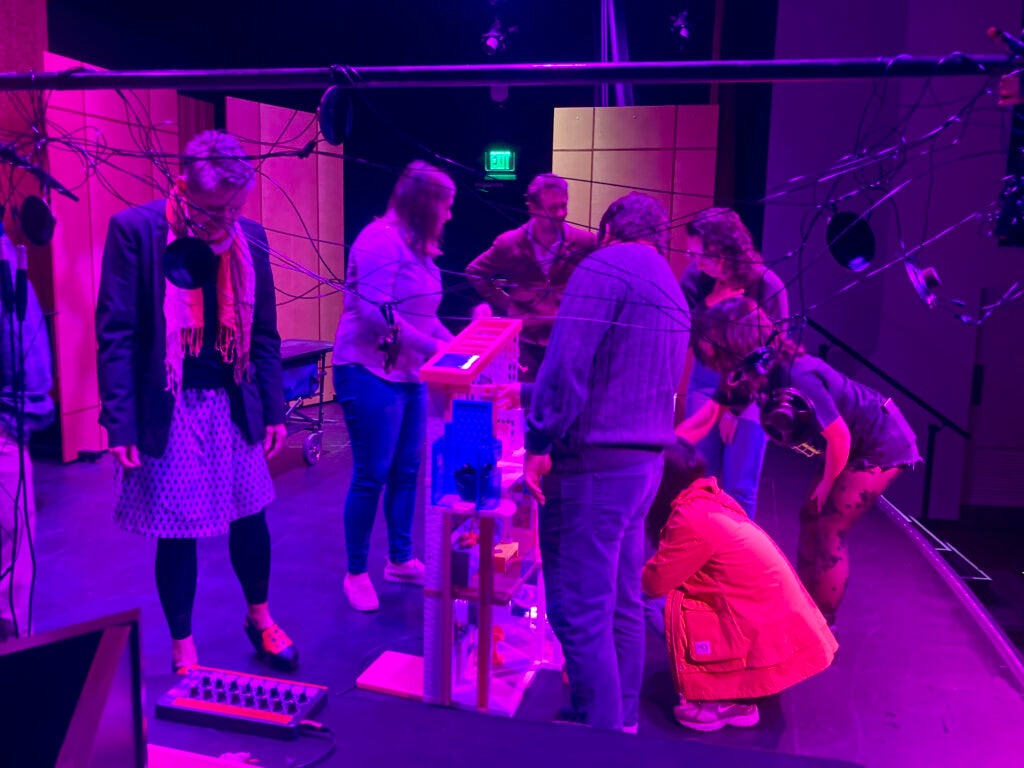
Yvette Janine Jackson’s radio opera ‘Harvest’ sows seeds of sound at UCLA Nimoy Theater
From the Daily Bruin: The Center for Musical Humanities hosted award-winning composer Yvette Janine Jackson with her Radio Opera Workshop at the Nimoy.