



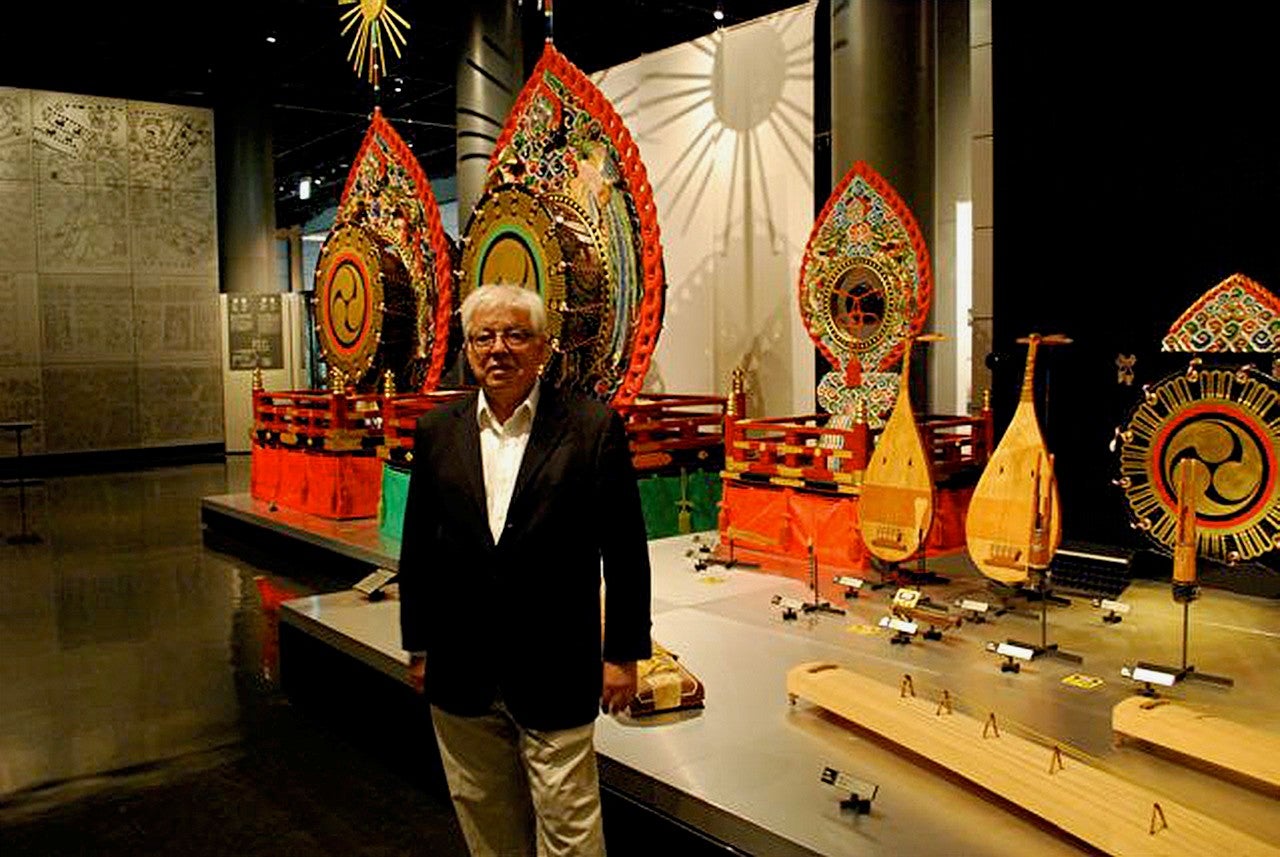
Robert Garfias arrived at UCLA in the summer of 1956. In the fall of 1956, he was given a graduate assistantship to manage the Ethnomusicology Archive. He worked on adding recordings from China (PRC), Burma, Vietnam, Thailand, and Japan to the Archive’s holdings. When he returned from Japan in 1961, he again worked in the Archive, accessioning Mantle Hood’s fieldwork recordings from Java. He also dubbed and accessed the Colin McPhee 78 rpm discs. Garfias continued his work in the Archive until he left for Seattle, Washington, in the fall of 1962.
During his time at UCLA, Garfias researched Gagaku for both his master's thesis and his doctoral dissertation. The focus of his research was a study of the living contemporary practice of Gagaku in the Japanese Imperial Palace and to trace, from historical documents, the patterns of change that occurred during the 900 years of its practice in Japan. Garfias’ master’s thesis was titled “The Basic Melody of the Tōgaku Pieces of the Gagaku Repertoire.” Garfias was UCLA Ethnomusicology’s very first MA graduate in 1958. Garfias' dissertation in 1965 was titled “The Tōgaku Style of Japanese Court Music: An Analysis of Theory in Practice.” A version of his dissertation titled Music of a Thousand Autumns: The Tōgaku Style of Japanese Court Music was released as a book by the University of California Press in 1975.
In 1959 the Japanese imperial court musicians toured the United States. Garfias toured with them as an interpreter. They performed three nights at UCLA, where Garfias gave the introductory lecture each night. Garfias wrote the program booklet for the tour, Gagaku: The Music and Dance of the Japanese Imperial Household (New York: Theatre Arts Books, 1959).
The UCLA Music of Japan Ensemble began in 1956 as a Gagaku group led by then-graduate student Robert Garfias. In May 1960, the Music of Japan Ensemble performed in the Festival of Oriental Music and the Related Arts. Produced by Mantle Hood, this event, now called the Spring Festival of World Music, has taken place annually ever since. The Music of Japan Ensemble remained an extra-curricular “study group” until 1964–1965, when Music 45G/145G: Music of Japan was offered for the first time. Instructors of the Music of Japan Ensemble included: Robert Garfias (1956–1961), Suenobu Togi (1961–1993), Mitsuru Yuge (1962–1989), Ikuko Yuge (1962–2001), Naoko Terauchi (1995-1996), and Bill Shozan Schultz (1995–2001).
During his academic career Robert Garfias founded the ethnomusicology program at the University of Washington, served as Dean of the School of Fine Arts at the University of California, Irvine, and conducted significant periods of fieldwork and language study around the world, including in Japan, Korea, Burma, Okinawa, the Philippines, Mexico, Central America, Zimbabwe, Romania, Turkey, and Spain. Garfias was appointed to the National Council on the Arts of the National Endowment for the Arts and also the Smithsonian Council. He served as a senior research fellow for the Japanese National Museum of Ethnology in Senri (Osaka), Japan. In 2005 the Government of Japan awarded Robert Garfias the Order of the Rising Sun, Gold Rays with Neck Ribbon, for his service to humanity.