

Aditi Sreenivas’s experiences span continents, from Bangalore to New Jersey to California. When she arrived at UCLA, she loved music but lacked a clear idea of how music might become her career. Through the music industry program, she discovered a world far larger than performance alone—one filled with paths in business, law and technology.
As she launches her own career in the music industry, Sreenivas is thinking critically about the future of the industry, the challenges of AI, and the benefits of belonging to a music community.
You’re from New Jersey, but you moved to California during high school. What was it like growing up in New Jersey?
It was definitely a combination of two different worlds. My parents are immigrants from Bangalore in South India, so I always felt very connected to that culture. Most of my family is still there, and I’ve been back a few times. But growing up in New Jersey, I was also very aware of American pop culture—what my classmates were listening to, what music videos they were watching, all of that.
What stood out to you about balancing those two cultures?
I was really drawn to the sense of individual expression in pop music. I loved watching music videos and seeing artists tell their own stories. A lot of Indian music, especially in Bollywood and classical traditions, is built around performing music written and composed by others. It’s similar to Western classical music in that sense.
So I found it fascinating that my peers connected so deeply with pop artists through personal storytelling. Sometimes it even felt like I was rebelling a little against what my parents were trying to instill in me by listening to that music. But I always carried both influences with me.

You later moved to Irvine in Orange County. What was that transition like?
Initially, it was a culture shock—in a good way. I went from a less diverse environment to one that was incredibly diverse, with lots of Indian students, Asian students, and people of color in general. It was amazing to be surrounded by people who also had immigrant backgrounds and understood that experience of growing up in America while maintaining strong cultural ties at home.
I also got exposed to so many different cultures through my friends. I started listening to a lot of K-pop because I had Korean friends, and I learned more about Japanese culture and other cultural traditions. It was a really formative experience.
Did you study music growing up?
Mostly voice. I trained vocally and sang in a lot of choirs throughout school.
When you came to UCLA, you started as a political science major. Did you already see music as part of your future?
Not really. Coming from an immigrant background, creative careers can sometimes feel less stable than traditional academic or professional paths. I didn’t really know studying music was even an option for me.
In seventh grade, I discovered that there was such a thing as the music business—that you could work in music through law or business. That motivated me to study political science and start on the pre-law track. But once I got to UCLA and learned about the Music Industry major, it felt like the best of both worlds.
I also realized there was a huge community of students who wanted to work on the business and legal side of music, so I decided to double major.
What do you ultimately want to do in the music industry?
I do want to go to law school eventually. Right now, though, I’m working at Apple Music.
What do you do there?
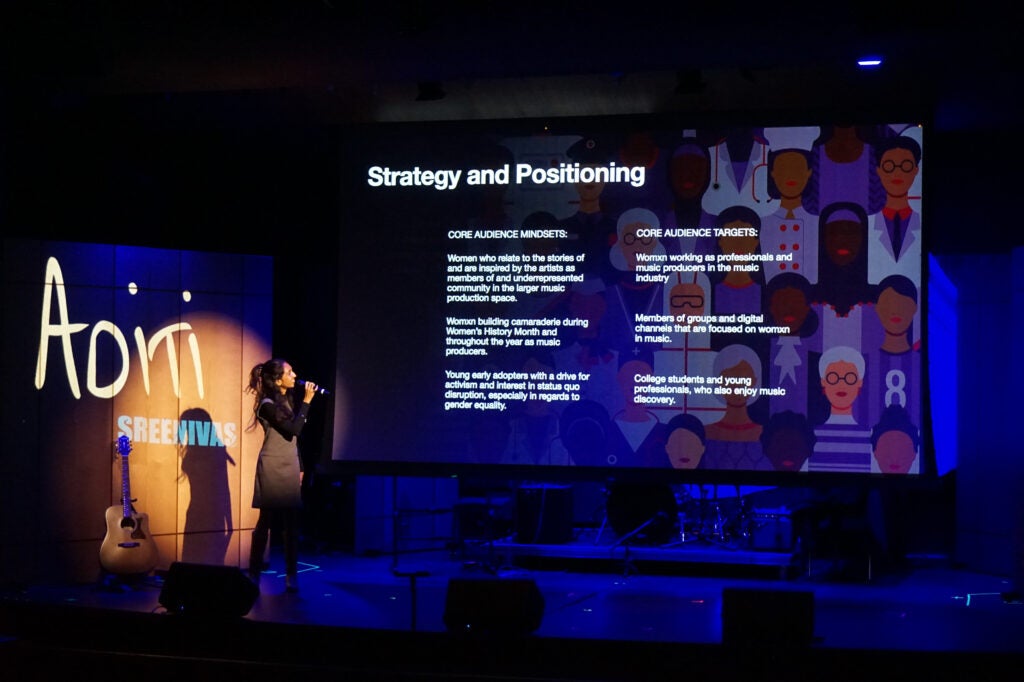
I work in campaign management. I help manage exclusive content campaigns with artists, acting as a liaison between artist teams and internal stakeholders. There’s a lot of project management, coordination, presentations, and communication involved.
How did you land that role?
I interned there this past summer. Before that, I’d interned throughout the music industry, including at Warner Music Group. I also interned at Apple TV+ on the business and legal side, and that eventually helped pave the way to Apple Music.
How’s the job been so far?
It’s been great. I’m just really excited to be working in music.
You’ve spoken about false dichotomies in the way we think about music, and the need to reject them in order to find new paths. Can you give an example?
I think the biggest example right now is the conversation around AI and technology in music. A lot of the conversation feels polarized—either fully embrace AI or completely reject it.
But the reality is that music will always exist. People will always create and share art. At the same time, technological progress is inevitable. I think UCLA students are especially good at being forward thinkers, and that’s something I want to address: how we can embrace artistry while also engaging thoughtfully with technological change.
Do you see AI as presenting new threats to musicians?
I think it raises a lot of important legal and ethical questions—especially around training data, name-image-likeness rights, and ownership. Those are issues that still need to be worked out.
But in terms of music creation itself, we’ve seen similar fears before whenever new technologies emerge. People worried synthesizers or Auto-Tune would fundamentally diminish music, but instead artists used those tools to create entirely new art forms. I’m really interested to see how musicians respond creatively to AI and how it changes the way we make music.
Let me give you the final word about your time at the school of music.
I’m really proud of the music community here at UCLA. We live in a time of great political and social disruption. Society is really polarized, and sometimes that seems like the only way to express your opinions. But I feel like the music community here at UCLA challenges that entire paradigm, just by sharing our stories, sharing thoughts and calling for unity and progress.