Eclectic jazz musicians come together to honor John Coltrane: jazz innovator, spiritual icon of the Black Arts Movement and patron saint of the avant-garde. Meditations/Infinity comes to UCLA's historic Schoenberg Hall.
Featuring
Camille Thurman-Greene Quartet
String Quintet (Juliette Jones)
Frank Lacy Quintet
Featuring: Frank Lacy, trombone, trumpet, French horn; Salim Washington, flute, tenor sax, oboe; Johnathan Blake, drums; Yayoi Ikawa, piano
with special guests: Jacques Lesure, guitar; Steve Loza, trumpet; Cheryl Keyes, flute; Regina Carter-Garnett, violin
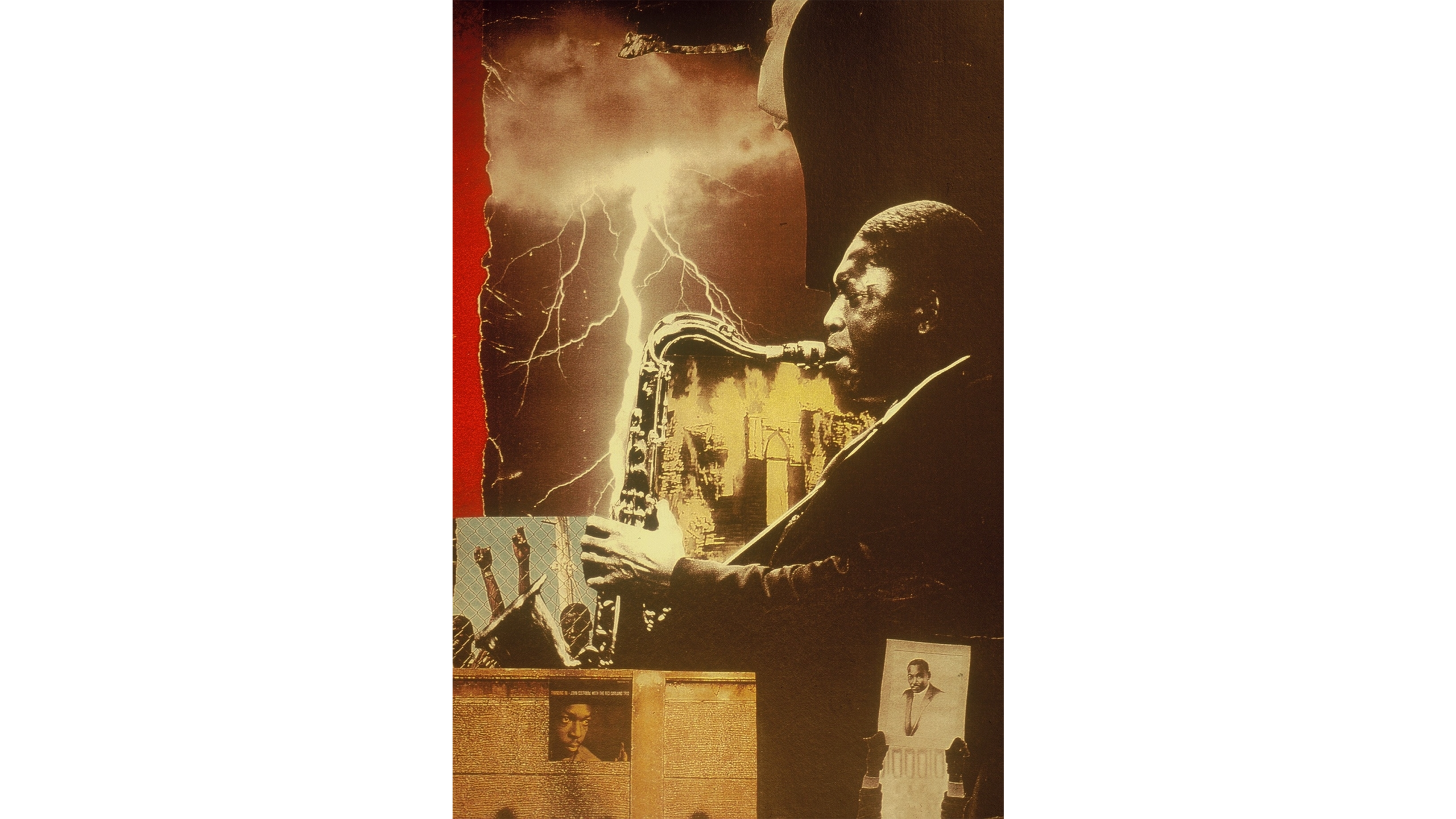
Theodore A. Harris, Coltrane's Thunderclap, 1998, paper collage. 11X17in
ABOUT THE ART WORK
Theodore A. Harris, Coltrane’s Thunderclap. 1998, paper collage, 11×17 in.
Theodore A. Harris (1966-) is a Philadelphia-based visual artist and poet. His work has been exhibited nationally and internationally and is in private and public collections such as Libraries and Museum University of Delaware, Fort Garland Museum and Cultural Center, University of New Mexico Art Museum, Saint Louis University Museum of Art, La Salle University Art Museum, Pennsylvania Academy of the Fine Arts, McGill University Visual Arts Collection, Center for Africana Studies; University of Pennsylvania, Kislak Center Rare Books and Manuscript Library; University of Pennsylvania, and the Petrucci Family Foundation Collection of African American Art, and the Winston and Carolyn Lowe Collection. Harris is the co-founder of the Anti-Graffiti Network/Philadelphia Mural Arts Program. Harris has also co-authored and authored books including Our Flesh of Flames (2019), Malcolm X as Ideology (2008) with Amiri Baraka, TRIPTYCH with Amiri Baraka and Jack Hirschman (2011), i ran from it and was still in it with Fred Moten (2007), and Thesentür: Conscientious Objector to Formalism (2017). He is the Founding Artistic Director of the Institute for Advanced Study in Black Aesthetics. LEARN MORE: THEODORE A. HARRIS – Home
RSVP to secure a seat. Also, please join us for the symposium celebrating John Coltrane on Friday, October 9 at 2 pm in Lani Hall. Both events are free and open to the public.
This event is FREE! No RSVP required. Early arrival is recommended.
PARKING
Self-service parking is available at UCLA’s Parking Structure #2 for events in Schoenberg Music Building and the Evelyn and Mo Ostin Music Center. Visitor parking is marked by a green circle and the letter “P” and is on the lower levels (do not go up the ramp to levels 3-7). Costs range from $5 for 1 hour to $17 for all day. Evening rates (after 4 p.m.) are $3-$6 for 1 to 2 hours and $12 for all night. Please verify all rates with campus parking, as they are subject to change. Learn more about campus parking.
ACCESSIBILITY
The UCLA Herb Alpert School of Music is eager to provide a variety of accommodations and services for access and communications. If you would like to request accommodations, please do so 10 days in advance of the event by emailing ADA@schoolofmusic.ucla.edu or calling (310) 825-0174.
PHOTOGRAPHY
The UCLA Herb Alpert School of Music welcomes visitors to take non‐flash, personal‐use photography except where noted. Share your images with us @UCLAalpert / #UCLAalpert on Twitter + Instagram + Facebook
FOOD & DRINK
Food and drink may not be carried into the theaters. Thank you!
Acknowledgment
The UCLA Herb Alpert School of Music acknowledges the Gabrielino/Tongva peoples as the traditional land caretakers of Tovaangar (the Los Angeles basin and So. Channel Islands). As a land grant institution, we pay our respects to the Honuukvetam (Ancestors), ‘Ahiihirom (Elders) and ‘Eyoohiinkem (our relatives/relations) past, present and emerging.