
uclaFLUX Spring 2026
UCLA Herb Alpert School of Music
Friday June 5, 2026
Lani Hall
5:00pm
Performers
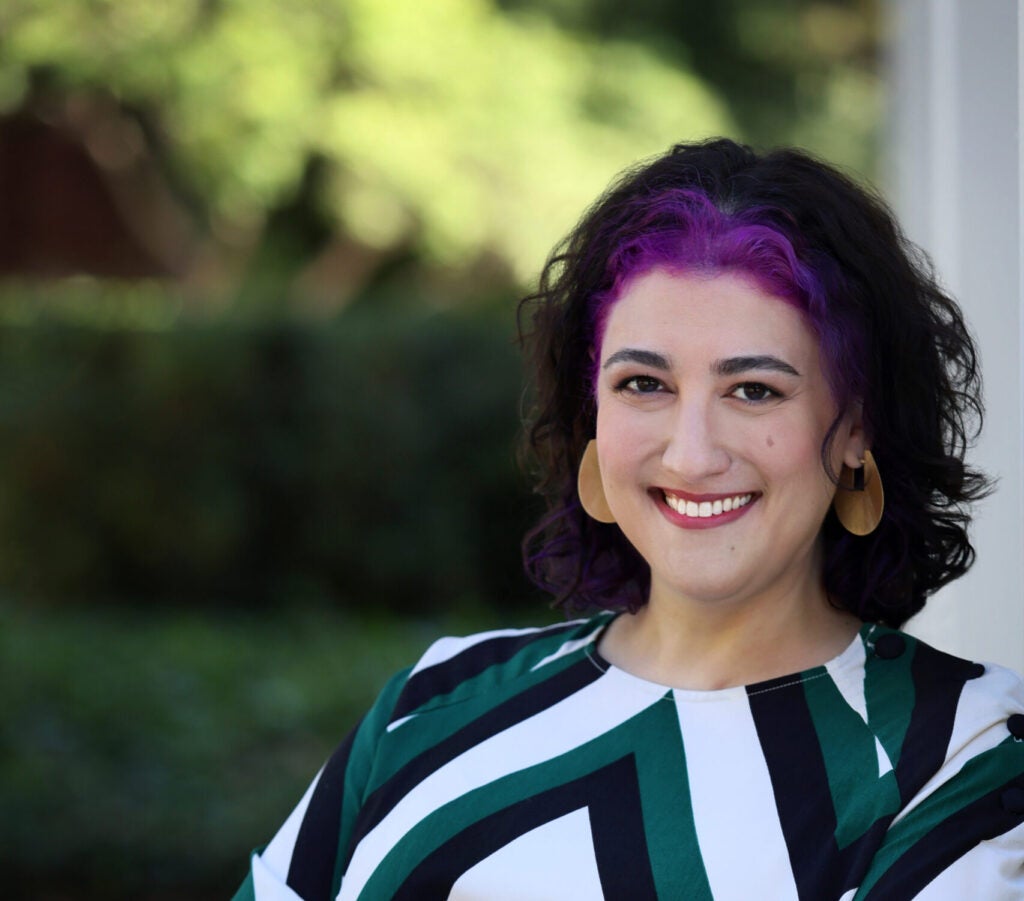
Wendy Richman
See Bio
Violist Wendy Richman has been celebrated internationally for her compelling sound and “absorbing,” “fresh and idiomatic” interpretations with “a brawny vitality” (The New York Times, The Washington Post). As soloist and chamber musician, she has performed at Carnegie Hall, Walt Disney Concert Hall, Royce Hall, Metropolitan Museum of Art, Mostly Mozart Festival, and international festivals in Berlin, Darmstadt, Edinburgh, Helsinki, Hong Kong, Karlsruhe, Morelia, and Vienna.
Richman is a founding member of the International Contemporary Ensemble (ICE), with whom she performs regularly in New York City and around the world. She collaborates with a wide range of composers, including commissions of works in which she sings and plays simultaneously. Her debut solo album, vox/viola, was released on New Focus Recordings (2020). She frequently performs with Los Angeles Chamber Orchestra and Los Angeles Philharmonic, and she has been a regular guest with Orpheus Chamber Orchestra and the orchestral viola sections of Atlanta, Minnesota, and St. Louis.
Also a distinguished educator, Dr. Richman serves as an academic lecturer at UCLA and as the viola instructor at California State University at Northridge (CSUN). She is a sought-after clinician at universities and conservatories across the country, offering classes on viola repertoire and technique, lectures on string instrument notation, and workshops on contemporary string techniques. She holds degrees from Oberlin Conservatory (BM), New England Conservatory (MM), and Eastman School of Music (DMA with Diploma in Ethnomusicology).
Dr. Richman’s research interests address musicians’ communities, stemming from her own experiences with composer-performer relationships, gender-based discrimination, and disability. Her own compositions link her love of unconventional string sounds with reflections on nature, physical trauma, and invisible disability.
uclaFLUX
About the Ensemble
uclaFLUX (Dr. Wendy Richman, director) is devoted to the study and performance of chamber music from the 20th and 21st centuries. We explore and embrace new performance approaches and techniques associated with the dynamic, ever-evolving languages of contemporary music, building on skills learned through the study of traditional chamber music.
In preparing to perform and produce quarterly concerts, students learn innovative modes of expression, interact directly with composers, and develop skills in concert promotion, production, and entrepreneurship. Repertoire is selected according to enrollment, though pre-formed groups and repertoire requests are welcome.
One of uclaFLUX’s major goals is to highlight music by living composers, especially Los Angeles-area, California, and West Coast composers, with a particular focus on works by composers who are BIPOC, LGBTQIA+, women/gender-marginalized, disabled, and from other groups underrepresented in classical and contemporary classical music.
Repertoire
Pre-concert (Schoenberg lobby):
Sonic Gestures (2026)
New intermedia work
James Fan, Chelly Jin, Samantha Reavis
Led and coordinated by Chelly Jin
Of a Feather (2024)
Caroline Mallonee (b. 1975)
Amelie Yap, oboe
Haruka Taguchi, soprano saxophone
Makiba Kurita, violin
Samantha Reavis, piano
new cosmologies (2020)
inti figgis-vizueta (b. 1993)
Bryan Chiu, horn
Makiba Kurita, violin
Ellie Loya, violin
Luca Lesko, double bass
Aidan Neuman, double bass
intangible landscapes (2020)
Yaz Lancaster (b. 199x)
James Fan, flute
Samantha Reavis, piano
Ellie Loya, violin
Luca Lesko, double bass
Chelly Jin, dancer and choreographer
Worlds We Might Have Known (2025)
Eris DeJarnett
Bryan Chiu, horn
Michelle Yang, horn
Andrew Fresquez, bass trombone
Myrmecia (2016)
Karola Obermüller (b. 1977)
Seamus Byrne, guitar
Jillian Risigari-Gai, harp
Dante De Silva, hammered dulcimer
INTERMISSION
Árvore (2025)
Marcos Balter (b. 1974)
James Fan, bass flute
Cyrus Asasi, clarinets
Joseph Ehrenpreis, electric guitar
Samantha Reavis, piano
Makiba Kurita, violin
Ellie Loya, violin
Johannes Eberhart, viola
Luka Lesko, double bass
Aidan Neuman, double bass
Demitrius Alleyne, percussion
Dante De Silva, electronics
Andrew Fresquez, conductor
The Book of Spells (2020)
I. CHAPTER ONE: LOVE AND RELATIONSHIPS
The Siren’s Seduction
Clarice Assad (b.1978)
James Fan, flute
Amelie Yap, oboe
Cyrus Asasi, bass clarinet
Jillian Risigari-Gai, harp
Johannes Eberhart, viola
Linaia-Agon (1972)
Iannis Xenakis (1922-2001)
Michelle Yang, horn
Raphael Yap, trombone
Ryan Heisinger, bass trombone
Program Notes
All notes and biographies are courtesy of the composers unless otherwise indicated.
Tonight’s program explores sonic worlds of unexpected and unconventional tunings, tonalities, and techniques, realized in works that vary widely in style and content. The pieces share threads of nature, mysticism, mythology—the liminal space between natural and supernatural, real and unreal, rational and mysterious. The title Worlds We Might Have Known is borrowed with gratitude and permission from Eris DeJarnett.
Sonic Gestures (2026)
Led and coordinated by Chelly Jin
Laptop, webcam, bluetooth speaker, and rolling cart.
This intermedia experiment explores the virtual instrument through hand gestures. Movements are captured by laptop cameras and translated through a machine-learning model trained to recognize hand poses and finger placements. The performer’s fingers map to musical parameters in a modular synthesis environment. Through a chain of transformations – from gesture to image, image to data, data to frequence, frequency to spatialized soundscape – the piece evokes a sense of curiosity and mystery.
Chelly Jin (she/her) is a Korean American new media performance artist, synthesizing computational programming, installation, and multimedia performance. Using choreographic research and custom software, her works act as microcosms: desires to quantize the body in a datafied society, software’s entanglements in embodied labor, and negotiations between computational and phenomenological memories. Her interdisciplinary practice builds upon critical theory in computational history, archival material, and algorithmic expression.
She also teaches creative technologies, as a guest faculty at the Anderson Ranch Art Center and instructor at the Social Software Code & Art Summer Institute at UCLA, and previously served as a curriculum writer for the Processing Foundation.
Of a Feather (2024)
Caroline Mallonee
This piece is an exploration of ideas inspired by the movements of birds – both a small group of birds, together on a wire, and a huge murmuration of starlings, sweeping through the air.
Caroline Mallonee (b. 1975) is an award-winning composer and performer based in Buffalo, NY. Inspired by scientific phenomena, visual art, and musical puzzles, Mallonee has been commissioned to write new pieces for prominent ensembles including the New York Philharmonic, the Buffalo Philharmonic Orchestra, Spektral Quartet, Firebird Ensemble, Present Music, Wet Ink Ensemble, Antares, PRISM Quartet, Ciompi Quartet, Ethos Percussion, and the Buffalo Chamber Players, for whom she serves as composer-in-residence. Mallonee’s music has been programmed at venues in New York City including Carnegie Hall, Lincoln Center, Symphony Space, Merkin Hall, Bargemusic, Tenri Cultural Center, Town Hall, Roulette, Subculture, and Tonic, as well as further afield at the Long Leaf Opera Festival (NC), Carlsbad Music Festival (CA), Bennington Chamber Music Conference (VT), Cambridge Music Festival (UK), Tokyo Opera City (Japan), the Corcoran Gallery (Washington, DC), Turner Ballroom (Milwaukee, WI) and Jordan Hall (Boston, MA).
Her music has been performed by soloists including pianists Eric Huebner, Steven Beck, Stephen Gosling, and John McDonald, as well as Haruka Fujii (percussion), Natasha Farny (cello), Miranda Cuckson (violin), Amy Glidden (violin), Salley Koo (violin), Feng Hew (cello), Janz Castelo (viola), Julia Tom (cello) and Kimberly Sparr (viola).
The New York Philharmonic included her music on its CONTACT! new music series at National Sawdust in 2015 and commissioned a new piece for large orchestra as part of its Project 19 commissioning project. “Lakeside Game” was premiered in November 2025 in David Geffen Hall and will be performed by the New York Philharmonic at the Bravo! Vail Festival in 2026.
Mallonee has been recognized through commissions and awards from the Fromm Foundation, the New York State Council on the Arts (NYSCA), Meet The Composer, the Jerome Fund for New Music, and ASCAP, from which she received a Morton Gould Young Composers Award.
She is the director of the Walden School Creative Musicians Retreat, a week-long festival for composers and improvisers held in New Hampshire each June. She was a long-time faculty member of The Walden School Young Musicians Program, where she also served as Academic Dean. Mallonee sings professionally in Vocális Chamber Choir and Harmonia Chamber Singers and as a violinist, was a founding member of pulsoptional (based in North Carolina) and Glissando bin Laden (based in New York City).
She studied composition with Louis Andriessen at the Royal Conservatory of the Hague (Fulbright Fellowship, 2005), Scott Lindroth and Stephen Jaffe at Duke University (Ph.D. 2006), Joseph Schwantner and Evan Ziporyn at the Yale School of Music (M.M. 2000), and Bernard Rands and Mario Davidovsky at Harvard University (B.A. 1997).
new cosmologies (2020)
inti figgis-vizueta
I see fundamental connections between the improvisatory and interpretative processes in my music and the formation of new, imagined histories of indigenous peoples. I think violence lives in our bones and our blood and that we still feel remnants from the first settlers to murder and poison our ancestors. Imagining a future for us means imagining a past separate from the settler colonialism that killed so many of our mythologies and stories.
When I think about Steve Mackey’s piece Indigenous Instruments, I think about the power of a white man’s imagination. The power of being able to conjure into being a New Indigenous peoples, not ravaged by genocide. I imagine the power of being celebrated, featured, and written about for it. Perhaps it’s just a small piece in the scheme of things, but I can’t shake how much that piece radicalized me to tell my own stories, to imagine new pasts and futures, and to fundamentally understand that white people gain their power from stealing our traditions and knowledges, our proximity to the divine, the cosmological, and the truth.
inti figgis-vizueta (b.1993) is a composer and educator who works to reconcile historical aesthetics and experimental practices with trans & Indigenous futures. Described as an “ever-intriguing, rising new music star” (LA Times), whose “arresting…sparse, beautiful” (NPR Classical) work brings “a sense of true dramatic stakes” (New York Times), inti has been commissioned and performed by leading artists including the Los Angeles Philharmonic, Boston Symphony Orchestra, Cincinnati Symphony Orchestra, Phoenix Symphony, Oregon Symphony, American Composers Orchestra, New World Symphony, Los Angeles Chamber Orchestra, Ensemble Reflektor, Aspen Music Festival, Ojai Music Festival, Spoleto Music Festival, Kennedy Center’s Sounds of US Festival, International Contemporary Ensemble, Alarm Will Sound, Wild Up, Roomful of Teeth, Carnegie Hall’s Ensemble Connect, Kronos Quartet, Attacca Quartet, JACK Quartet, Music from Copland House, Crash Ensemble, pianist Conor Hanick, violinist Jennifer Koh, and cellists Andrew Yee and Jay Campbell, among many others. inti’s work has been featured at Lincoln Center, Carnegie Hall, Kennedy Center, Walt Disney Hall Concert Hall, Symphony Center, REDCAT, National Concert Hall (IE), Southbank Centre (UK), Philharmonie de Paris (FR), Muziekgebouw aan ‘t IJ (NL), and Konzerthaus Berlin (DE).
Upcoming projects include Rose Bond’s 1968 for the 2025 Venice Biennale, a new work for Trickster Orchestra’s 2026 TransTraditionale FESTIVAL, the NYC premiere of opera mad scramble for crumbs in Lincoln Center’s Rubenstein Atrium, and new works for flutist Claire Chase, organist James McVinnie, and cellist Andrew Yee with Roomful of Teeth. inti is the recipient of the 2026 United States Artists Fellowship, the Lotos Foundation Prize, ASCAP Foundation Fred Ho Award, National Sawdust Hildegard Award, Café Royal Foundation Music Grant and residency fellowships from Dumbarton Oaks, Civitella Ranieri, Juilliard Summer Percussion, and Music at Copland House.
inti has held faculty positions with Luna Composition Lab (21-24’), Wildflower Composers (20-22’), Fresh Inc Festival (22’), and Atlanticx Composition (21’). She regularly lectures on her music with recent visits to Harvard University, The Juilliard School, Peabody Conservatory, and CalArts, among many others. inti has curated programs for the Los Angeles Philharmonic Green Umbrella series, Los Angeles Chamber Orchestra Current Series, CalArts’ REDCAT, Wild Up’s Darkness Sounding, and American Composers Orchestra SONiC Festival. She was the 2024 Robert M. Trotter Plenary Keynote Lecturer for the College Music Society 67th National Conference.
inti studied with Marcos Balter, Felipe Lara, Donnacha Dennehy, and George Lewis. Her mentors include Tania León, Nico Muhly, Angélica Negrón, Derek Bermel, and Andrew Norman, among many others. inti honors her Quichua bisabuela who was the only woman butcher on the plaza central and used to fight men with a machete.
intangible landscapes (2020)
Yaz Lancaster
intangible landscapes deals with the growing feelings of ennui and isolation I encounter[ed] living in New York over the past six years, and how perceived landscapes of memory shift, breathe and transform over periods of time. Many people I love no longer live here. I question whether a home is a tangible, real place, or if it exists in the intangibility and quiet intimacy of created and/or remembered landscapes that can only exist ephemerally.
The expansive practice of experimental artist Yaz Lancaster is grounded in queer, DIY, and liberatory frameworks; and it utilizes electroacoustic composition, sampling/collage, improvisatory modes, and consideration of relational aesthetics. They are primarily concentrated on the cultivation of care & intimacy, multidisciplinary and/or post-genre collaboration, and prioritization of community & accessibility.
Yaz performs with their violin, voice, objects, and electronics. Following 2023 debut release AmethYst (people places), their 2025 album AFTER (PTP) navigates dreams, nostalgia, perceptive realities, and intimacies via textural soundscapes, obfuscated sampling, and purposefully degraded production techniques. Yaz frequently performs as versatile “death ambient” and hardcore project medium. (with gg200bpm). Recently, they have been drawn to long-form improvisation, club music, sound design, and production-forward songwriting. As a DJ, they combine percussive and traditional musics of the global south, Black American dance genres, and hardcore kicks in high-energy club sets – and “literally anything” for the radio in fluid narrative-driven mixes.
Yaz has had the opportunity to perform at Lincoln Center, The Shed, MoMA, Roulette Intermedium, Dweller Forever (at Public Records), National Sawdust, Nowadays, Paragon, MASS MoCA, The Poetry Project, The Music Gallery (Toronto) The Lot Radio, Issue Project Room, Trans-Pecos, Intercomm, and a billion other venues in NYC and internationally. As an active collaborator, Yaz has worked with artists including Centennial Gardens (Dreamcrusher + KING VISION ULTRA), claire rousay, Leilehua Lanzilotti, Lisel/Eliza Bagg, Miss Grit, Nyokabi Kariuki, and Vines. They have been commissioned by A Far Cry, Beth Morrison Projects, Black Mountain College Museum & Art Center (with Hub New Music), Brooklyn Youth Chorus, the Minnesota Philharmonic; and Opera Philadelphia – for which they created PAPER TIGER (2023) with filmmaker Sean Pecknold.
Recent projects include scoring & music directing Asia Stewart’s evening-length Fabric Softener (2024) at The Shed, and new work for International Contemporary Ensemble (2025). Yaz was nominated for a 2025 Gaudeamus Award; and was recently a Pioneer Works music resident (Feb-March ‘25).
Yaz is also a poet & (music/arts) writer, organizer, amateur powerlifter, and member of PTP Vision artist collective. HEAVY HEARTS is a live performance series they created to facilitate & celebrate vulnerability in sharing experimental sonics. They love horror, chess, reality competition television, and hearing people laugh.
Worlds We Might Have Known (2025)
Eris DeJarnett
In the aftermath of deep trauma, it’s not uncommon to dwell on what life was like before everything changed and how things might have turned out had we been spared the pain. And when we consistently take the time to look at the state of the world, it’s very easy to find ourselves bogged down by wave after wave of devastation as we watch legions of horrors being visited upon our fellow humans every day. The resulting grief can be overwhelming as we struggle to comprehend everything from mass death to starvation to the strategic and intentional denial of lifesaving medical care. Given the ease with which we can access this information in the social media era, it’s relatively common to get stuck in a mournful loop of “this could have been avoided” and find ourselves endlessly ruminating on how things might have been had a specific terrible event never happened.
While Worlds We Might Have Known was born out of a need to process the immense grief I have experienced in recent months and years while bearing witness United States-sponsored violence both domestically and abroad, I caution those who encounter this work not to frame it as an eternal state. Grief is an ever-changing landscape, which I have tried to reflect through the restarted phrases and ultimately abandoned modal mixtures that permeate the piece. The mere slivers of musical dreaming the performers begin with are ultimately the only things they’re left with in the end, because the point of this piece isn’t escapism. There’s no rewriting the past, and it would be a disservice to those we’ve lost to build a world where their deaths are forgotten. Ultimately, Worlds We Might Have Known is about letting go of perhaps-sweeter versions of reality which are no longer available to us. It is a reverent kiss goodbye.
Eris DeJarnett (e/they) is an interdisciplinary narrative artist working with music, text, and movement to examine power structures, community, and queerness within and beyond the performing arts and academia. Hailed as having “a keen affinity for vulnerability, in both eirself and others,” eir musical catalog explores sexual assault, trauma, recovery, gender, and neurodivergence, often centering the human voice amidst soundscapes of experimental and noise-based practices. Eris’ work also emphasizes the importance of personal development at the performer’s own pace—musically and otherwise—and they regularly work with student musicians and developing performers to craft pieces which suit their individual needs. Eir music has been presented across the United States and internationally, from the National Trumpet Competition and the International Trumpet Guild Conference to the Re:Sound Festival, Oh My Ears, and countless performances both formal and casual.
Eris’ work as an educator has included teaching trumpet, composition, popular music history, and technology-centered career strategies at the postsecondary level. E has given guest lectures for a range of audiences, including at SUNY Potsdam, Hendrix College, Arizona State University, and Brass Out Loud. Eris also engages in policy and structural analysis on their website via the written word and as a consultant for a variety of performing arts organizations. Eris holds an MFA from the Performer-Composer program at CalArts and a BM in Theory and Composition from Arizona State University. Eir primary teachers include Mattie Barbier, Nicholas Deyoe, Tim Feeney, Kotoka Suzuki, and Jody Rockmaker. They currently call both the Pacific Northwest and the Detroit, Michigan metro area “home.” In eir spare time, you can find em advocating for trans kids and learning how to be a trans adult. To learn more about Eris’ work, please visit https://erisdejarnett.com.
Myrmecia (2016)
Karola Obermüller
Myrmecia was composed in 2015-16 for the unusual combination of guitar, hammered dulcimer, and harp. The title is derived from the name of an Australian species of ant, Myrmecia (bulldog ant). The piece is an exploration of microtonal tunings specifically tailored to the instruments involved. The subtle tuning is based on the inclusion of upper partials using Ben Johnston’s system of “extended just intonation”, but mingled with the partly well-tempered tuning of the dulcimer. By restricting the harmony as greatly as possible, the ear focuses more closely on the delicate microtonal events on the horizontal level. Thanks to the threefold layering of sound, the instruments’ characteristic sound production, whether plucked or struck, ensures a dense sequence of string attacks. The high register, combined with the microtonal beats and percussive sound generation, evokes an almost exotic crackling and a persistent sonic flux. The composer compares it to the wild activity and even brutal assertiveness of the primordial ant. – Volker Blumenthaler
Karola Obermüller composes in search of the unknown, with layers upon layers of obscured material buried deep beneath a surface that is sometimes sumptuous, sometimes bristling with rhythmic energy. Her unique voice began forming in collages of sound made with tape recorders as a child and evolved later with composition degrees from the Meistersinger-Konservatorium Nürnberg, the Hochschule für Musik Saar, and the University Mozarteum Salzburg. Her sense of rhythm and form was forever changed by studying Carnatic and Hindustani classical music in Chennai and Delhi, India.
A Ph.D. at Harvard University brought her to the US where she taught at Wellesley College and at the University of New Mexico, co-directing the composition area and the annual John Donald Robb Composers’ Symposium music festival, before joining the Department of Music at UC San Diego. She also lives and works part of the year in Europe and has been a visiting artist at ZKM, Karola Obermüller composes in search of the unknown, with layers upon layers of obscured material buried deep beneath a surface that is sometimes sumptuous, sometimes bristling with rhythmic energy. Her unique voice began forming in collages of sound made with tape recorders as a child and evolved later with composition degrees from the Meistersinger-Konservatorium Nürnberg, the Hochschule für Musik Saar, and the University Mozarteum Salzburg. Her sense of rhythm and form was forever changed by studying Carnatic and Hindustani classical music in Chennai and Delhi, India.
A Ph.D. at Harvard University brought her to the US where she taught at Wellesley College and at the University of New Mexico, co-directing the composition area and the annual John Donald Robb Composers’ Symposium music festival, before joining the Department of Music at UC San Diego. She also lives and works part of the year in Europe and has been a visiting artist at ZKM, Deutsche Akademie Rom, Centro Tedesco di studi Veneziani, Akademie Schloss Solitude, Leipzig Gewandhaus and Hanns Eisler House, and IRCAM as well as serving as a resident composer for new music festivals at Hochschule für Musik Nürnberg, Conservatorio Piccinni di Bari (Italy), University Mozarteum Salzburg, Festival Virtuosi Century XXI, Recife (Brazil), Samobor Music Festival Croatia, and others. Obermüller frequently serves as an adjudicator for competitions such as the Felix Mendelssohn Bartholdy Hochschulwettbewerb, the Femfestival, and the Kranichsteiner Musikpreis of the Darmstadt Ferienkurse.
Her music, often political, always dramatic, includes operas for Staatstheater Nürnberg, Theater Bielefeld, Theater Bonn, Theater Heidelberg, and Stuttgart’s Musik der Jahrhunderte. The emotional juxtapositions of story suspended in a tableau architecture that one finds in her operas can be heard in her concert works as well which include commissions from the Ernst von Siemens Music Foundation, the National Endowment for the Arts, the Fromm Music Foundation, New Music USA, Bayerischer Rundfunk, Saarländischer Rundfunk, and numerous renowned soloists and ensembles.
Obermüller works with lauded contemporary music ensembles such as Ensemble Modern, ICE (International Contemporary Ensemble), Arditti Quartet, Neue Vocalsolisten, Ekmeles, MusikFabrik, Le Nouvel Ensemble Moderne, E-MEX Ensemble, Iridium Quartet, New Thread Quartet, Soli fan tutti, Pegnitzschäfer Klangkonzepte, Ensemble Adapter, New Mexico Contemporary Ensemble, ensemble phorminx, sonic.art saxophone quartet, Splinter Reeds, Gewandhaus-Ensemble Avantgarde, and AsianArt Ensemble. She has received numerous awards including the Heidelberger Künstlerinnenpreis, Darmstädter Musikpreis, the New York Musicians Club Prize, the ASCAP Morton Gould Young Composer’s Award, the Bavarian Youth Prize for Composition (awarded by Zubin Mehta), the John Green Prize for Excellence in Music Composition, and the 1st Prize of the “New Note” International Composers Competition Croatia.
Recordings of several of Obermüller’s works have been released on CD including Jacqueline Leclair’s solo CD (New Focus Recordings, Music for English Horn Alone, FCR272), a record by harpsichordist Luca Quintavalle (Brilliant Classics 96476: Mousikē—the art of the muses), a CD with the Voices of the Pearl project (Volume 3), and a disk by Duo Harmonium d’art et Pianoforte (forthcoming on dreyer-gaido). Having been selected by the German Music Council to be a part of the Contemporary Music Edition, the first portrait CD of her music was released by WERGO in 2018 and a second CD is forthcoming on New Focus Recordings.
The Book of Spells (2020)
Clarice Assad
I have long been intrigued by anything unexplained with pure logic, so occult themes, witchcraft, and the fantasy world have long been companions of my imagination. The Book of Spells is a three-movement composition inspired by rituals that deal with magic, which is done to achieve a particular goal, righteous or wicked. Each movement explores a rite and follows the reasoning of a book I came across. The chapter sections are thematic, each focusing on assorted areas of interest: Chapter one deals with matters of the heart (Love and Relationships); Chapter Two is about bringing wealth and prosperity into one’s life. Chapter Three is about Health and well-being. Within each chapter, hundreds of spells teach the practitioner how to prepare and perform the rites, each for a particular purpose. The Book of Spells was commissioned by Elisabeth Remy Johnson on behalf of The Merian Ensemble and made possible in part by a grant from The American Harp Society.
A powerful communicator renowned for her musical scope and versatility, Brazilian-American Clarice Assad is a significant artistic voice in the classical, world music, pop, and jazz genres. The Grammy Award–nominated composer, celebrated pianist, inventive vocalist and educator is acclaimed for her evocative colors, rich textures, and diverse stylistic range.
What motivates Assad? What drives her passion and creativity? Writing and playing music that inspires and encourages audiences’ imaginations to break free of often self-imposed constraints is just the beginning. She endeavors to harness the incredible and intangible power of music to connect people and transform lives through original works, commissions, and education programs that give voice to everything from the impact of climate change to issues of social justice, gender equity, and the empowerment of young voices.
With her talent sought-after by artists and organizations worldwide, the polyglot musician continues to attract new audiences both onstage and off. In the recording arena, Assad has released seven solo albums and appeared on or had her works performed on another 34. Her music is represented on Cedille Records, SONY Masterworks, Nonesuch, Adventure Music, Edge, Telarc, NSS Music, GHA, and CHANDOS. Her innovative and award-winning VOXploration education series on music creation, songwriting, and improvisation has been presented throughout the world.
The prolific composer has more than 70 works to her credit, including numerous commissions for Carnegie Hall, the Chamber Music Society of Lincoln Center, the Boston Youth Orchestra, Chicago Sinfonietta, San Jose Chamber Orchestra, the Bravo! Vail Music Festival, and the La Jolla Music Festival, to name a few. Her compositions have been recorded by some of the most prominent names in classical music, including percussionist Dame Evelyn Glennie, cellist Yo-Yo Ma, violinist Nadja Salerno-Sonnenberg, and oboist Liang Wang. Assad’s music has been performed by the Philadelphia Orchestra, Tokyo Symphony, Queensland Symphony, and the Orquestra Sinfônica de São Paulo. She has served as a composer-in-residence for the Albany Symphony, the Cabrillo Festival of Contemporary Music, New Century Chamber Orchestra, and the Boston Landmarks Orchestra. Her works are published in France (Editions Lemoine), Germany (Trekel), Brazil (Criadores do Brasil), and in the U.S. by Virtual Artists Collective Publishing (VACP), a publishing company she co-founded with poet and philosopher Steve Schroeder. Assad recently wrote the soundtrack to Devoti Tutti, a documentary by Bernadette Wegenstein, and is composing the music for a ballet by award-winning choreographer Shannon Alvis.
As a performer, Assad has shared the stage with Bobby McFerrin, Anat Cohen, Nadia Sirota, Paquito D’Rivera, Tom Harrell, Marilyn Mazur and Mike Marshall, among others. She has performed at internationally renowned venues and festivals including The Netherlands’ Concertgebouw, Carnegie Hall, Belgium’s Le Palais des Beaux-Arts, Le Casino de Paris, Jazz at Lincoln Center, and the Caramoor International Jazz Festival.
Assad also strives to expand the sonic palette of the voice, including immersing audiences in the music as active participants and by electronically altering sounds, “like one of those cooks who can turn any four random foodstuffs into a feast” (Classical Voice North America).
She takes the immersive experience outside of the concert hall with the innovative and accessible VOXploration, which she created in 2015. The program offers a creative and fun approach to music education through meaningful, interactive experiences. It has been carefully curated to work equally well with participants of any age or musical background. It has received numerous grants and awards from Brazilian foundations such as CAIXA CULTURAL and SESC, as well as American organizations New Music USA and the McKnight Foundation. Assad has given master classes, residencies, and workshops throughout the United States, Europe, and the Middle East.
Born in Rio de Janeiro, Clarice Assad is one of the most widely performed Brazilian concert music composers of her generation. The recipient of numerous honors and awards, amongst them an Aaron Copland Award and several ASCAP awards in composition, she holds a Bachelor of Music degree from the Roosevelt University in Chicago, and a Master of Music degree from The University of Michigan School of Music.
Árvore (2025)
Marcos Balter
[“Árvore” is Portuguese for tree.]
At Guadeloupe’s Mémorial ACTe, a museum dedicated to the history of the transatlantic slave trade, I stood quietly before a life size replica of a Tree of Forgetfulness. In parts of Africa, the captured once circled such trees after hanging personal tokens on their branches, entering a trance meant to erase names, memories, and selves, softening the traumatic descent from human to cargo before the Atlantic crossing. I mourned my ancestors and felt the bitter irony of using a tree, so deeply tied to roots, ancestry, and memory, as an instrument of erasure. Árvore (the Portuguese word for tree) imagines these trees not just as keepers of a painful past but as fertile organisms from which freed versions of the captured are reborn, not emptied of self but fortified by the power of kinship and collective memories. Within the work, a quote from an Afro-Brazilian chant for the Yoruba orixá Oxumarê, often linked to movement, transformation, and continuity, underlines the idea of rootedness and regeneration, where what was meant to be forgotten instead becomes a source of new and expanded life.
Marcos Balter: I was born in Rio de Janeiro, Brazil, and began my musical training at a very young age at the Conservatório Musical Heitor Villa-Lobos, later continuing at the Conservatório Brasileiro de Música. In my late teens, I studied privately with the late composer Almeida Prado before moving to the United States to pursue undergraduate and graduate studies in Composition. During my doctoral studies at Northwestern University, I became deeply immersed in Chicago’s experimental music scene, forming long-term creative relationships and co-founding Ensemble Dal Niente. After teaching at Columbia College Chicago, I moved to New York in 2014 to join the faculty at Montclair State University, followed by a professorship at the University of California San Diego. In 2022, I returned to New York, where I am the Fritz Reiner Professor of Musical Composition at Columbia University. During the summers, I also teach composition and co-coordinate the composition program at the Tanglewood Music Center. I became an American citizen in 2024, once it became possible to do so while maintaining my Brazilian citizenship. Both countries are home to me, as is New Zealand, where my husband is from.
I am a queer Black composer whose work grows out of experimental music and long-standing engagement with Afrodiasporic and Afrofuturistic thought. At the center of my practice is collaboration, not simply as a practical necessity, but as a creative philosophy. I am drawn to processes that ask what music can be, how it is made, and who gets to shape it. Many of my projects develop through extended workshops rather than traditional rehearsal models, allowing ideas to emerge gradually through dialogue, shared labor, and sustained listening. This approach has led me to work with a wide range of people and contexts, including non-musicians, classical and popular musicians, dancers, poets, scholars, community organizations, and groups focused on social change.
I describe my compositional approach as resonant humanism. By this, I mean a way of making music that places human presence, vulnerability, and attentive listening at the center of the work. Rather than treating sound as something imposed by a composer and executed by performers, I understand it as something that emerges through bodies, spaces, and relationships. My music often favors resonance over force, interaction over display, and instability over control. Musical gestures are frequently fragile and open-ended, inviting performers to navigate uncertainty and difference together in real time.
Much of my work draws inspiration from Yorùbá mythological cosmology, especially through the orishas. I approach these traditions not as symbols to be illustrated, but as living systems of thought. They have shaped many of my works, spanning acoustic and electroacoustic solo pieces, chamber music, large ensembles, and full orchestral works. Across these pieces, myth, ritual, and history serve as starting points for exploring sound, movement, labor, and technology, while remaining attentive to histories of displacement, erasure, and resilience. As fortunate as I am to work regularly with well-known artists, ensembles, and orchestras around the world, long-term, close collaboration with specific performers remains at the very heart of my practice. Many of my works grow out of creative relationships that have developed over many years, grounded in trust, shared curiosity, and a genuine investment in one another’s artistic growth. My collaborations with artists such as flutist and educator Claire Chase, conductor and bassoonist Rebekah Heller, violist and curator Nadia Sirota, and the late saxophonist Ryan Muncy reflect more than two decades of close dialogue and mutual artistic exploration. These relationships are not only professional, but deeply personal, shaping the music through repeated experimentation, conversation, and a willingness to take risks together. I have had the privilege of working closely with many of the most dedicated conductors, performers and ensembles in the new music community, including a particularly long and meaningful partnership with the International Contemporary Ensemble, with whom I have collaborated for twenty years.
My work as a composer is inseparable from my work as an educator and public thinker. In academic settings, I design courses that foreground diverse musical traditions, critical engagement with history, and experimental approaches to sound. Beyond the university, I regularly take part in public conversations about music and culture through workshops, audience talks, and interdisciplinary panels with artists, architects, playwrights, and scholars. I see these activities not as side projects or outreach, but as integral to how I understand composition itself: a shared inquiry that remains open to other forms of knowledge, lived experience, and collective thinking.
At heart, my desire as an artist is to be in conversation with others, and especially with people whose experiences, perspectives, and ways of listening differ from my own. I am most drawn to situations where music becomes a meeting place, a space for exchange, curiosity, and mutual transformation.
Linaia-Agon (1972)
Iannis Xenakis
According to the legend, Linos, the celebrated musician, provokes Apollo, who strikes him down. Here the legend is incarnated by a musical game between two adversaries. Linos = the trombone, Apollo = the French horn or the tuba [or bass trombone]. Contrary to the legend, this game gives Linos a chance to extricate himself. This actual chance is mathematically provided by decision matrices. To throw the gauntlet to the gods is not blasphemy but is to surpass them by surpassing oneself. – Iannis Xenakis
Giannis Klearchou Xenakis (also spelled for professional purposes as Yannis or Iannis Xenakis) was a Romanian-born Greek-French avant-garde[2] composer, music theorist, architect, performance director and engineer.[3]
After 1947, he fled Greece, becoming a naturalised citizen of France eighteen years later.[4] Xenakis pioneered the use of mathematical models in music such as applications of set theory, stochastic processes and game theory and was also an important influence on the development of electronic and computer music. He integrated music with architecture, designing music for pre-existing spaces, and designing spaces to be integrated with specific music compositions and performances.[5]
Among his most important works are Metastaseis (1953–54) for orchestra, which introduced independent parts for every musician of the orchestra; percussion works such as Psappha (1975) and Pléïades (1979); compositions that introduced spatialization by dispersing musicians among the audience, such as Terretektorh (1966); electronic works created using Xenakis’s UPIC system; and the massive multimedia performances Xenakis called polytopes, that were a summa of his interests and skills.[6]
Among the numerous theoretical writings he authored, the book Formalized Music: Thought and Mathematics in Composition (French edition 1963, English translation 1971) is regarded as one of his most important publications. As an architect, Xenakis is primarily known for his early work under Le Corbusier: the priory of Sainte-Marie de La Tourette, on which the two collaborated, and the Philips Pavilion at the 1958 Brussels World’s Fair (Expo 58), which Xenakis designed by himself.[citation needed] – Wikipedia, the free encyclopedia
Acknowledgements
Special thanks to Rob Baker, James Bass, Lindsey Beardsley, Theresa Dimond, Adam Gilberti, Luis Henao and the HASoM AV team, Andrew Ordonez, and Matthew Vest.
Huge thanks to Haruka Taguchi and Michelle Yang for their generosity and hard work as they stepped into new pieces very late in the game!
This quarter, we have been privileged to work with all seven of the program’s living composers. Clarice Assad, Eris DeJarnett, inti figgis-vizueta, Yaz Lancaster, Caroline Mallonee, and Karola Obermüller joined us from all over the world for thought-provoking Zoom coachings, and Marcos Balter shared terrific demonstration videos and answered many questions over email. Tubist Luke Storm (DMA 2016) joined the Xenakis group for an invaluable coaching and discussion about Linaia-Agon and the intricacies of its game component. Several of the composers made large and small adjustments to their scores to accommodate our instrumentation, some of them intricate and last-minute. Thank you to all of these exceptional musicians for their musicianship, expertise, and energy.
Support for this course was provided by the UCLA Teaching and Learning Center (TLC) to advance educational innovation; elevate teaching; and foster engaging, accessible learning experiences for all students.
Thank you to Tim Feeney for the use of his hammered dulcimer.
Immense gratitude to Prof. Dante De Silva for his help (a woefully inadequate word) with so many things throughout the quarter. A few of the tasks he took on: learning a brand-new instrument, running electronics, helping with extended techniques, coaching when I was out of town, and bringing me tacos when I was clearly beyond hangry. Dante has been a dream of a musician, colleague, and friend.
Thank you to these incredible, intrepid student musicians for the hard work, curiosity, and high level of music-making they have brought to this music.
Thank YOU for joining us! Please follow us on Instagram: @uclaFLUX, and contact Wendy Richman (wendyrichman@g.ucla.edu) to discuss donations that will allow us to continue our important work with living composers!
