

The UCLA Herb Alpert School of Music presents
Celestial Bodies
Theresa Dimond, Director
Monday, March 2, 2026
8:00pm
UCLA Schoenberg Hall
Performers
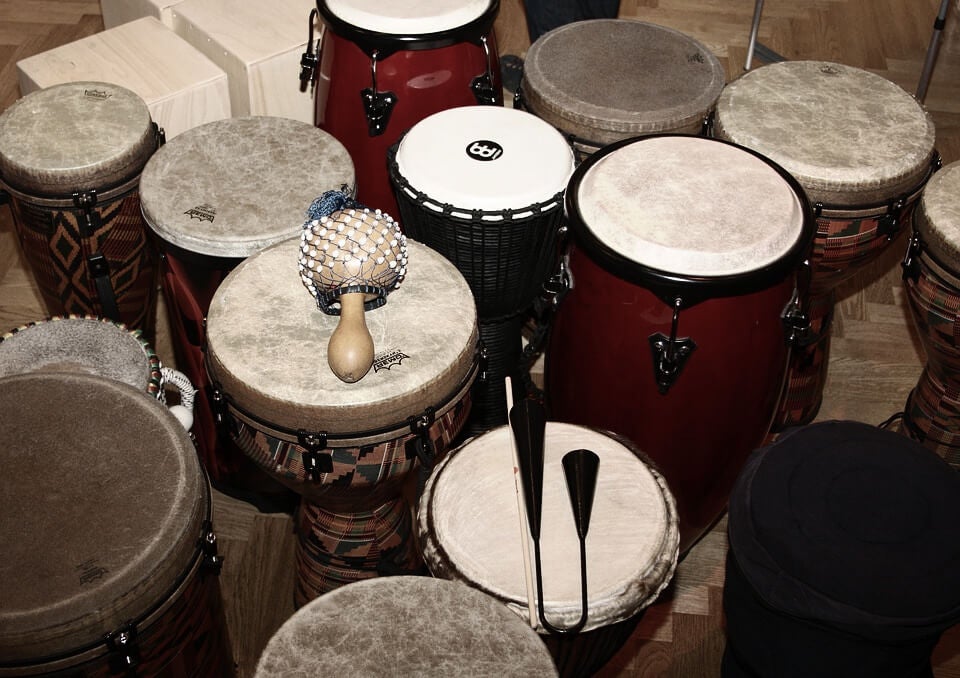
UCLA Percussion Ensemble
See Roster
Demetrius Alleyne
Rathul Anand
Justin Barker
Madison Bottenberg
Andrew Chang
Alexa Clawson
Robert Darling
Henry Fairbanks
Isaiah Gilliam
Isaac Gonzalez
Tu Han Huynh
London Johnson
Alexander Lee
Trey Tappan
Liam Tran
Trent Williams
Julie Xiang
Harry Zheng
Program order
Over the Edge (1995) by Steven Fitch (b. 1957)
Post-Sunrise (2016) by Caleb Pickering (b. 1990)
from The Planets, Op. 32 (ca. 1914-1916) Jupiter by Gustav Holst (1874-1934), arr. Nathan Daughtrey
SUN (2010-2011) by Baljinder Singh Sekhon, II (b. 1980)
INTERMISSION
Symphony of Palms (1994) by Gordon Hughes (b. 1975)
Passover’s Falling (2015) by Adam R. Miller (b. 1986)
Cuban Concerto (2006) by Edward Freytag
Madison Bottenberg, snare drum soloist
from Undertale (2008) Megalovania by Toby Fox (b. 1991), arr. Robbie Good
Program Notes
Over the Edge by Steven Fitch
Composer Steven Fitch provides the following program notes:
“Over the Edge is dedicated to my friends and partners in the Kalamazoo Percussion Trio, Marcus Linke and Heriko Schafer. It originated as the finale of a three-movement work entitled Turns of Phrase. Each movement of Turns of Phrase employs some type of turning or rotation.
Over the Edge, a tornadic tour de force for three players, allows the performers and audience to experience motives, accents, and stick and rim clicks as they whirl around the three triangularly arranged two drum set-ups. The reason for the paradiddle and paradiddle-diddle stickings is the homogeneous feel and natural inner crescendo they lend to those passages. This is intrinsic to the piece.
Using the theme and variations form, this work explores the concept of going over the edge from order into chaos. The natural order of the introduction, theme and first two variations begins to unravel in Variation Three, through the juxtaposition of a 4/4 accompaniment against a 7/8 duet, ultimately leading into the completely chaotic Variation Four (7/8 against 5/8 against ¾). This is the heart of the piece, where accents on the rims of the Chinese tom toms shoot out like random gunfire. Order is restored in variations 5 -7, but the previous chaos has given birth to a certain freneticism which imbues the entire coda with an anxious, almost hurried quality, leading eventually to the final rim outburst and the last truncated utterance of the theme with its explosive final stroke.”
Post-Sunrise by Caleb Pickering
Post-Sunrise is a flowing, post-rock style quintet scored for glockenspiel, vibraphone, two marimbas, suspended cymbal, djembe and ankle bells. Written in a binary form, this minimalist work features large sections of three against four motoric rhythms. The B section abandons the rhythmic focus, becoming more harmonic in conception, and slower in rhythm with each percussionist contributing one note to a slow five note motivic cell. The composer uses a repeated single pitch to facilitate a compound-metered transition, before returning to the motoric polyrhythms of the A section. The work closes with slow moving bell-like tones, reminiscent of the previous B material.
Post-Sunrise was composed in the summer of 2014 during a one-month bed-ridden, recovery from surgery.
Caleb Pickering is a graduate of the University of Nevada, Las Vegas and Texas A & M University, Commerce. He has studied percussion with Dean Gronemeier, Timothy Jones and Brian Zator. As a percussionist and educator, Pickering performs frequently in the Dallas-Fort Worth and North Texas areas.
Jupiter from The Planets by Gustav Holst
Program notes provided by Marianne Tobias:
“In 1913, Gustav Holst visited Majorca. While there he became acquainted with astrology, which became a lifelong interest. He wrote to a friend:
“As a rule, I only study things which suggest music to me…. recently I became acquainted with astrology, and the character of each planet suggested logs to me, and I have been studying astrology fairly closely.”
Imogen Holst, the composer’s daughter, recalled that Alan Leo’s What is a Horoscope was one of her father’s favorite books. In the book, Leo described the planets, giving each a small description, and expanding upon the astrological significance of each. The Planets, Holst’s most popular work, reflects his characterization of the planets, with the exception of Earth and Pluto, which had not yet been discovered by 1917.
Central to astrological thought is the power of divination, forecasting, and fateful determination via the character and placement of the planets, following the maxim “as above, so below.” Today many call it pseudoscience because of its non-empirical basis, putting far more reliance on the science of astronomy, which developed from astrological inquiries. Holst was very taken by astrology, and in private parties liked to give “astrological readings” and casting horoscopes for his friends. He stands in a long continuum of philosophers, musicians, scientists, and artists who have pondered the mysteries of the cosmos and man’s relationship to it.
The fourth movement in this seven-movement work, Jupiter – The Bringer of Jollity is introduced by a toe-tapping syncopated dance, appropriate for the happy and festive mood portrayed in this movement. Holst’s love of English folk song and dance is obvious in this treatment. The middle section, a surprising contrast, is a majestic flowing melody in a 3/4 meter. This melody was later used for the British patriotic song, I Vow to Thee, My Country.”
Nathan Daughtrey’s arrangement for vibes and marimba beautifully encapsulates the sonorities of Holst’s gigantic orchestra in a vibrant duo.
SUN by Baljinder Singh Sekhon, II
The composer provides the following program notes:
“Scored for three percussionists, SUN explores a variety of musical energies. From tired phrases to extended climactic passages to short-lived bursts of sound, many segments of music are intertwined and overlaid in a way that creates a singular event (the piece) with various “flares” of sound on its surface. These segments are often separated by silent moments that, because of their context, each express a different type of energy.
The instrumentation of the individual percussion parts is very similar; that is, each percussionist has a keyboard instrument, “skin” (instrument with a drum head), wood, and metal. In addition, the percussionists share one large cymbal that is central to the staging. At times the three percussion parts are treated as one large instrument with three performers working towards one musical character. This orchestration and interaction alternates with each performer executing their own layers of sound to create a heterophonic texture. The percussionists use a multitude of techniques to create a palette of nuanced sounds. In addition to common performance practices, they use their hands, fingers, knuckles, arms, and fingernails to muffle, modify, and create a diversity of characteristics.”
Dr. Sekhon holds a Bachelor of Music degree from the University of South Carolina, and a Master of Arts and Ph.D. degree from the Eastman School of Music. While at Eastman, he was a three-time recipient of the Howard Hanson Orchestral prize and served as President of the highly acclaimed OSSIA New Music Ensemble. He previously served as Assistant Professor of Composition at the University of South Florida and is now Associate Professor of Composition at Penn State University.
Symphony of Palms by Gordon Hughes
Gordon Hughes is a 1996 graduate of the Queensland Conservatorium Griffith University. Prior to graduating, Hughes received numerous awards while also being the first Australian to receive a Licentiate degree in percussion from Trinity College, London. After completing his undergraduate studies, Hughes was nominated for Young Australian of the Year Career Achievement Award in 1999.
Alongside an active performing and conducting schedule that has seen him perform in all major Australian concert halls, Hughes is the founder and managing director of Rhythmscape Publishing Australia. As a composer, Hughes’ works have been performed throughout Australia, the UK and the USA to great critical acclaim.
Symphony of Palms is a work originally scored for seven hand-clappers. Although the work uses only hands and feet to make sounds, 11 different notational signs must be interpreted by the performers. Hughes quotes Handel’s Messiah, Bizet’s Carmen, and references rap, flamenco, and a gesture from the 1986 comedy film, Three Amigos.
Passover’s Falling by Adam Miller
The composer provides the following program notes:
“The Rosewood Bible encompasses a series of eight compositions based on Biblical writings, beginning with Eden for solo marimba, and ending with Revelation for percussion duo and piano. Each piece, although written for different types of ensembles, is meant to stand alone, or together as an entire series of programmatic works in a single performance.
Passover’s Falling is the second installment in The Rosewood Bible Series, and represents the story of the original Passover, one of the Bible’s most gripping and tragic events. In response to the Egyptian Pharaoh’s refusal to abolish the slavery of the Israelites, the angel of death passes over Egypt and kills the firstborn son of every home that isn’t sheltered by God. Told from the perspective of an Israelite family, the piece strives to capture the anticipation, edginess and fear these families experienced as the shadow of God passed over them.”
Adam R. Miller is a professional musician who received his Bachelor of Arts degree in Percussion Performance from McMurry University in Abilene, Texas. He has performed with the Hardin-Simmons University orchestra and the Abilene Philharmonic. He currently holds the position of Instructor of Percussion at Regents School of Austin in Texas.
Cuban Concerto by Edward Freytag
Cuban Concerto places snare drum, front and center, as a solo instrument, accompanied here by a nine-member Latin percussion ensemble. Based on the son clave rhythm, the work combines the technical control of rudimental snare drumming with the groove of Cuban folkloric music. The soloist’s cadenza showcases the many technical aspects of playing snare drum including the traditional “opening and closing of the roll,” Swiss army triplets, paradiddle diddles, double paradiddles, and flam accents.
Edward Freytag holds a Bachelor of Science Degree in Music Education from the University of Tennessee at Chattanooga and a Master of Music Degree in Jazz and Studio Performance from the University of Tennessee at Knoxville where he studied with renowned jazz educator, Jerry Coker, and drum set afficionado, Keith Brown.
Freytag has performed and toured extensively throughout the United States, Russia, Germany, England and the Caribbean Islands with such well-known artists as Liberace, Benny Goodman, Dizzy Gillespie, Randy Brecker, Eliane Elias, Steve Allen, Buddy Morrow, Donald Brown, Jerry Coker, Ron Miller, Ray Stevens, Bill Watrous, Terry Gibbs, Dr. Hook, the legendary Carl Perkins, and the Queen of Soul, Aretha Franklin. He has done openings for the likes of Kenny Chesney, Ray Stevens, Joe Diffie, Eddie Money, Tracy Lawrence, Rick Trevino, Billy Dean, Shaver, Radney Foster, Lorrie Morgan, Restless Heart, Martina McBride, Eddie Arnold, and Leroy Parnell. He has worked in management, promotions, production, and artist relations in the music industry in Nashville.
Megalovania from Undertale by Toby Fox
Megalovania is an instrumental video game song composed by Toby Fox. It was first composed for the Radiation’s Halloween Hack, a ROM hack of EarthBound, developed for a Mother fansite’s competition in November, 2008. The name Megalovania is a combination of “megalomania” and “Transylvania,” the latter which was intended to tie into the project’s Halloween theme. Ever popular, in January 2024, the Guinness Book of World Records certified Megalovania as the most streamed track from any video game soundtrack on Spotify with over 161 million streams.
This arrangement, by former UCLA Herb Alpert School of Music alumna Robby Good, was recorded and premiered during COVID by the UCLA Percussion Ensemble. The ensemble is proud to offer the first live performance of this wonderful arrangement for you this evening.
