
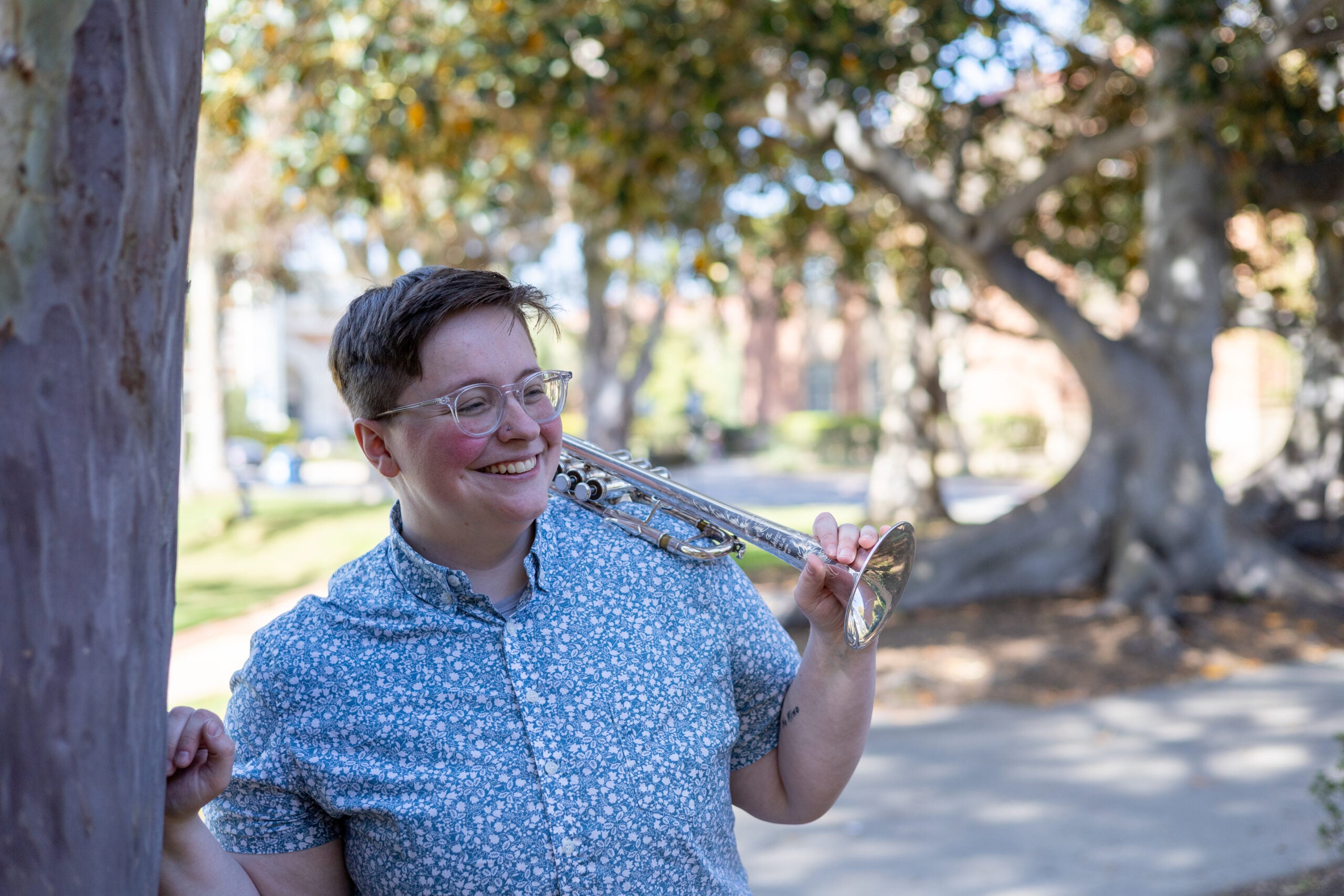
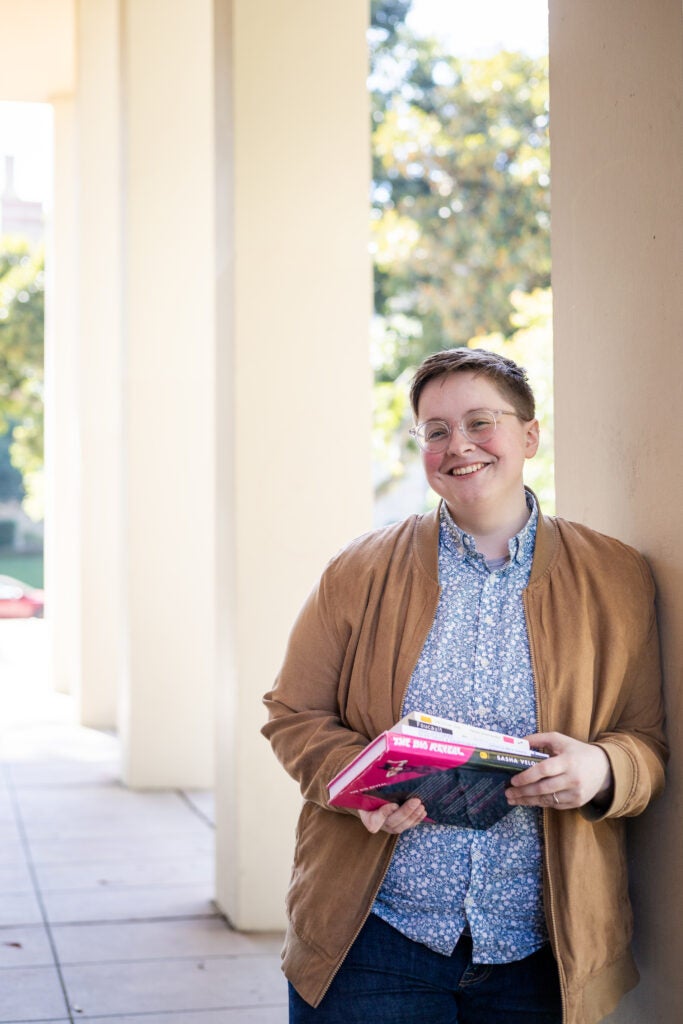
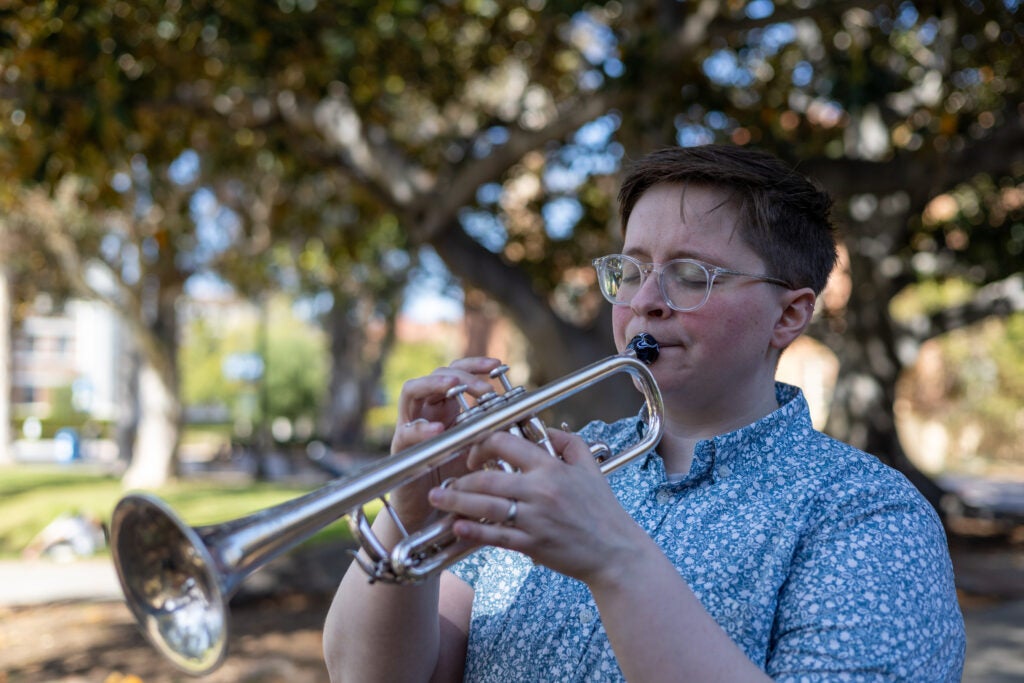
Morgan Bates is a doctoral candidate in the Department of Musicology. A trumpet player with a wide-ranging undergraduate background—Bates began as a political science major—they earned a master’s in performance before arriving at UCLA. Now advanced to candidacy, Bates has received the Margery Morgan Lowens Dissertation Research Fellowship from the Society for American Music.
Named for one of the society’s founders, the fellowship supports scholars in the early stages of dissertation research. The organization itself sits at the center of musicology, embracing a broad methodological range that spans anthropology, sociology, ethnomusicology, and sound studies.
We sat down with Bates to discuss their dissertation.
###
Were you a music major in college?
I started as a political science major, but pretty much immediately, I was drawn to music. And I took my first [private] trumpet lesson. I had played in high school band, but I never had any formal training. I loved it. So, at first, I thought I would minor in music. But after my first theory class, I was hooked. I ended up majoring in music and minoring in religion.
And then you continued your studies at the University of Oregon.
I did two master’s degrees there. I wanted to continue in musicology, and I applied to UCLA.
What is the subject of your dissertation?
My dissertation is titled “The Space in My Mouth, Drag Vocal Performance as Materialized with ‘Resistance’ in the United States.”
What will you be using the fellowship for?
I need to do field research in New York, Chicago and Atlanta, so I’ll be using the grant mainly for travel. And for my research to be successful, I need to go and not just stay for a night, not just schedule interviews and accomplish those tasks as an ethnographer. I really want to immerse myself in the scenes, experience what they experience, hear what they hear.
What specifically are you researching about drag?
I’m studying this concept that I call “drag vocality:” the social lives of voices in drag and performing within the drag industry, broadly defined. I’m interested in understanding how, queens, kings, monsters, and things are using this act of singing to engage with audiences and expand minds.
And I’m also curious about what drag performance means sensorially—the atmospheric conditions, like they use lighting and sound, all the way to questions like: what does it feel like? What does it smell like, taste like?
So you are interested in public performance and its audience?
Yes. Although I am concerned about being too restrictive when we use the term “public.”
How so?
Well, I was given a Cameo once for my birthday, where a queen sang Happy Birthday to me.
A Cameo?
Yes, it’s an app where you can pay a performer to recording something that you can send to a person. So for example, I have a friend who just got a job and I got him a cameo of a drag queen congratulating him on the job.
So it’s an application for sending messages in drag?
Oh no, doesn’t have to be drag. You can get Cameos from members of the cast of The Office. I think Chuck Norris is in there and available.*
Because of course he is.
Right! So that’s a private performance, but I would consider it public. That for me is fair game. It’s a weird “in between.” I like thinking about everything beyond just binaries, and I’m hoping that the dissertation allows us to explore that “in between” a lot more.
We have a lot of scholars who engage in this kind of research—it’s one of the reasons I came to UCLA in the first place.
Say more.
So Nina Eidsheim, I’ve taken a number of seminars with her, and I lean on her use of theory in Sensing Sound and The Race of Sound. Also Catherine Provenzano’s work on auto tune and asking questions of how processing systems affect how we categorize “humanness” in sound. And really, there are many more.
Where will you begin your research?
I had a paper accepted to a conference in New York, so I’ll start there. I have a couple of interviews lined up but I can’t even say who they are yet because I need to have all my documentation in order first so I can be certain about full consent.
Talk a little about your methodology.
It’s most important to me to be in these spaces, so I’m going to focus on a lot of thick description, everything that I experience. But I’m also going to do interviews with individuals to ask them questions and make sure that I have documented discussions, not just to have data, but to have something to go back to, to understand how I’m working with my own experiences and also how we might think about these like broader public scenes.
Best of luck as you start your research.
Thanks!
* This interview was conducted just before Chuck Norris’s passing. He was an icon that spanned generations and his inclusion is part of the historical record.