
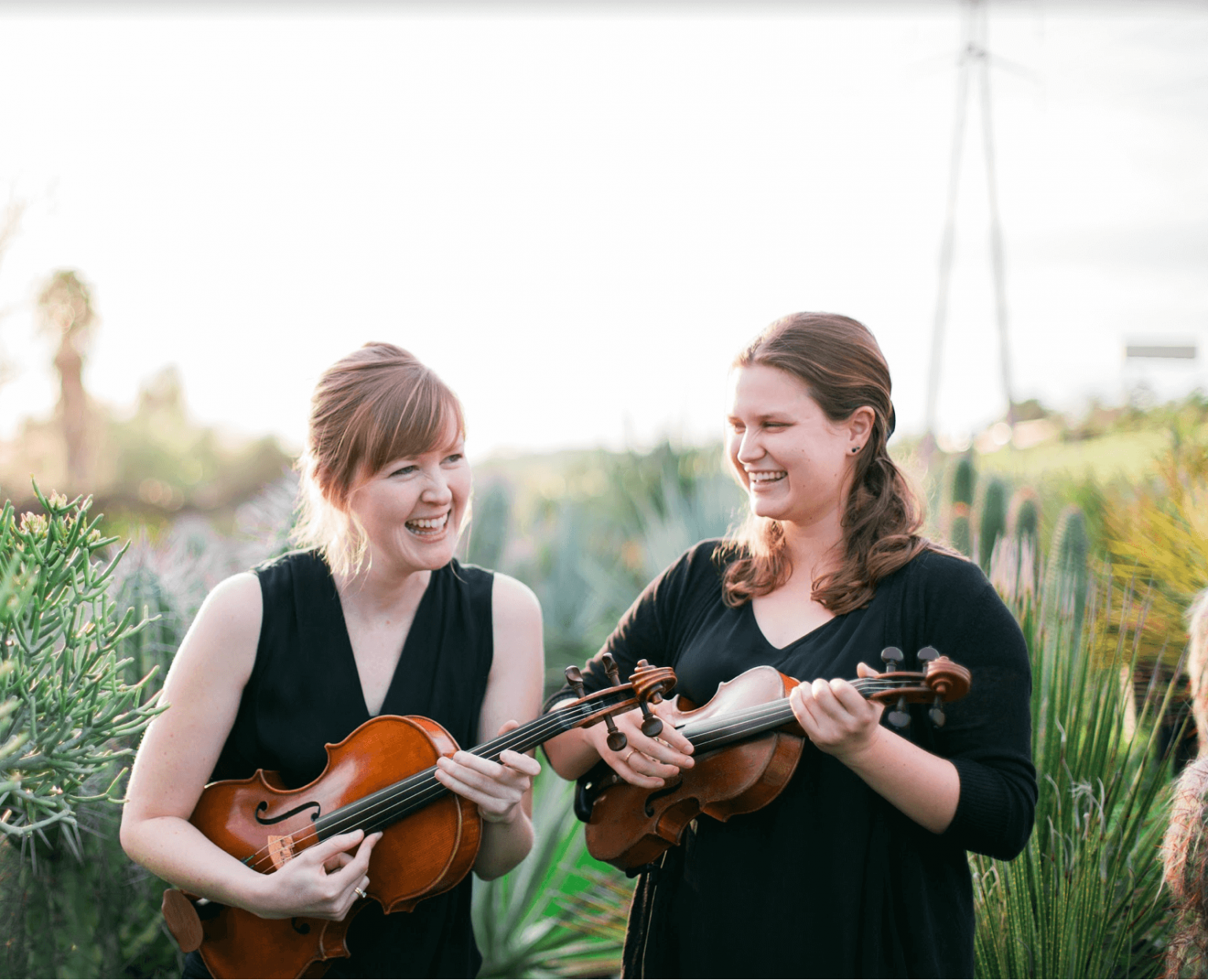
Aperture Duo, Concert of Faculty Works
The UCLA Herb Alpert School of Music, the Department of Music, the Joyce S. and Robert U. Nelson Fund, and the Hugo and Christine Davise Fund for Contemporary Music present an evening of faculty works performed by the Aperture Duo.
Performers & Composers
Repertoire
Dante De Silva, Evil Twin^ (2017)
Peter Golub, 3 Shorts for Violin and Viola^ (2022)
David Lefkowitz, JellyFish^ (2022)
- Intermission -
Kay Rhie, In Spatium^ (2022)
Noah Meites, Water and Power* (2016)
*Aperture Duo Commission
^ World Premiere
Program Notes
Evil Twin, for violin, viola, and electronics (2017)
Evil Twin is inspired by how kids, when caught doing something untoward, may bend and manipulate their recounting of the actual events to soften any punishment they may receive. The piece uses two samples (created by violin and viola individually) as a representation of the actual events. Throughout the piece, the electronics gradually manipulate the samples, which gives the live instruments new fragments and gestures to create new melodies. Towards the end of the piece, both samples are stretched to the point where they line up rhythmically and harmonically (like when elements from two different accounts of the same event line up), and the violin and viola play their new melodies that have evolved from the samples.
This piece is dedicated to Cameron, my dear friend since elementary school, and someone who used to do untoward things with me in our youth.
This piece was written for Adrianne Pope and Linnea Powell of Aperture Duo.
3 Shorts for Violin and Viola (2022)
3 Shorts for Violin and Viola is hot off the press. After hearing Aperture's demonstration for students I felt compelled to write for them. Tonight we are only hearing the first and third pieces; both are slow and lyrical. The second movement, which is light and fast, was not ready in time for tonight's concert. These pieces, like short films or short stories, are condensed versions of their full-length cousins. A space is left for what is un-said.
JellyFish (2022) for Violin and Viola
JellyFish (also called simply “Jellies”) have an amazing life-cycle. They spend half of their lives anchored to the sea floor, appearing for all intents and purposes to be plants. At a certain point, however, these “polyps” grow a stalk made up of multiple plate-shaped clones, which then detach and start to swim away. These “ephyrae” mature into “medusae,” the potentially large and tentacled organisms we usually imagine. The medusae use their stinging tentacles to capture food and to bring it within their delicate bodies, but only until the conditions are right for reproduction, at which point they spawn, expelling “gametes” (sperm or unfertilized egg) into the water; medusae will typically then die. Fertilized eggs will subsequently hatch into flat worm-like ciliated “planulae.” These planulae will swim toward the bottom, where they will anchor themselves and develop into polyps once again. Some jellyfish have an added complication in this already-complicated life-cycle: if the conditions for reproduction do not occur or if the medusae are under threat, they may return to the ocean floor and reattach, once again becoming polyps (jellyfish in this planula/medusa cycle can actually be said to achieve immortality!)
JellyFish is a game piece, imagining two different jellies starting at opposite sides of their respective life-cycles. The game proceeds through repeated cycles until the two players find themselves in the same part of the life-cycle. If they do not come together within two circuits of the life-cycle, however, the life-cycle shortens to the planula/medusa “immortal” sub-cycle, which then repeats until they successfully come together.
The duration of JellyFish is uncertain, but I expect that it would be around 5 or 6 minutes.
JellyFish is written for and is dedicated to the Aperture Duo.
In Spatium (2022) for violin and viola
In Spatium, or “in the distance”, is a piece about two people trying to be together, or align with each other. Born very much out of the pandemic experience, the six vignettes portray the desire to synchronize and sympathize with each other despite the distance forced upon us. The first two duet movements are followed by solo interludes, which then conclude with another pair of duets.
Movement I is hopeful and energetic;
Movement II is in perpetual motion with growing tension;
Movement III is a distorted elegy;
Movement IV is an exaggerated sigh;
Movement V is a whimsical dance;
Movement VI is about transcending the distance and gazing deeply into the other person
Water and Power (2016) for violin and viola
I wrote Water and Power in Los Angeles during the exceptionally hot summer of 2016. At the time, L.A. was suffering from a historic drought that brought the gap between the wealthiest Angelenos and everyone else into sharp relief – despite penalties for watering during the drought, the well-tended lawns and medians of Beverly Hills and Brentwood remained lush and green while most other parts of the city withered.
It was against this backdrop that I came across the fiddle playing of Bebe Carriere , one half (with his brother Eraste) of the “Carriere Brothers” a pivotal ensemble connecting early Creole style to modern zydeco – an African American dance-hall music from French-speaking southwest Louisiana blending blues, rhythm and blues, and indigenous Creole and Native American music. According to legend, Carriere’s first fiddle was crafted from a wooden cigar box strung with wire from a broken window screen. Echoes of this instrument are apparent in Carriere’s “Blue Runner,” a solo performance characterized by polyrhythmic counterpoint and the ethereal twang of hard metal strings. A transcription of this solo (as heard in Nick Spitzer’s 1986 documentary, Zydeco (https://www.folkstreams.net/film-detail.php?id=181) appears at key moments in Water and Power.
The distance between my home in Los Angeles and rural Louisiana is not as great as it might seem. In both places, ordinary people grapple with inequities of power magnified by the dire ecological consequences of those who wield it – not enough water here, too much there.
