
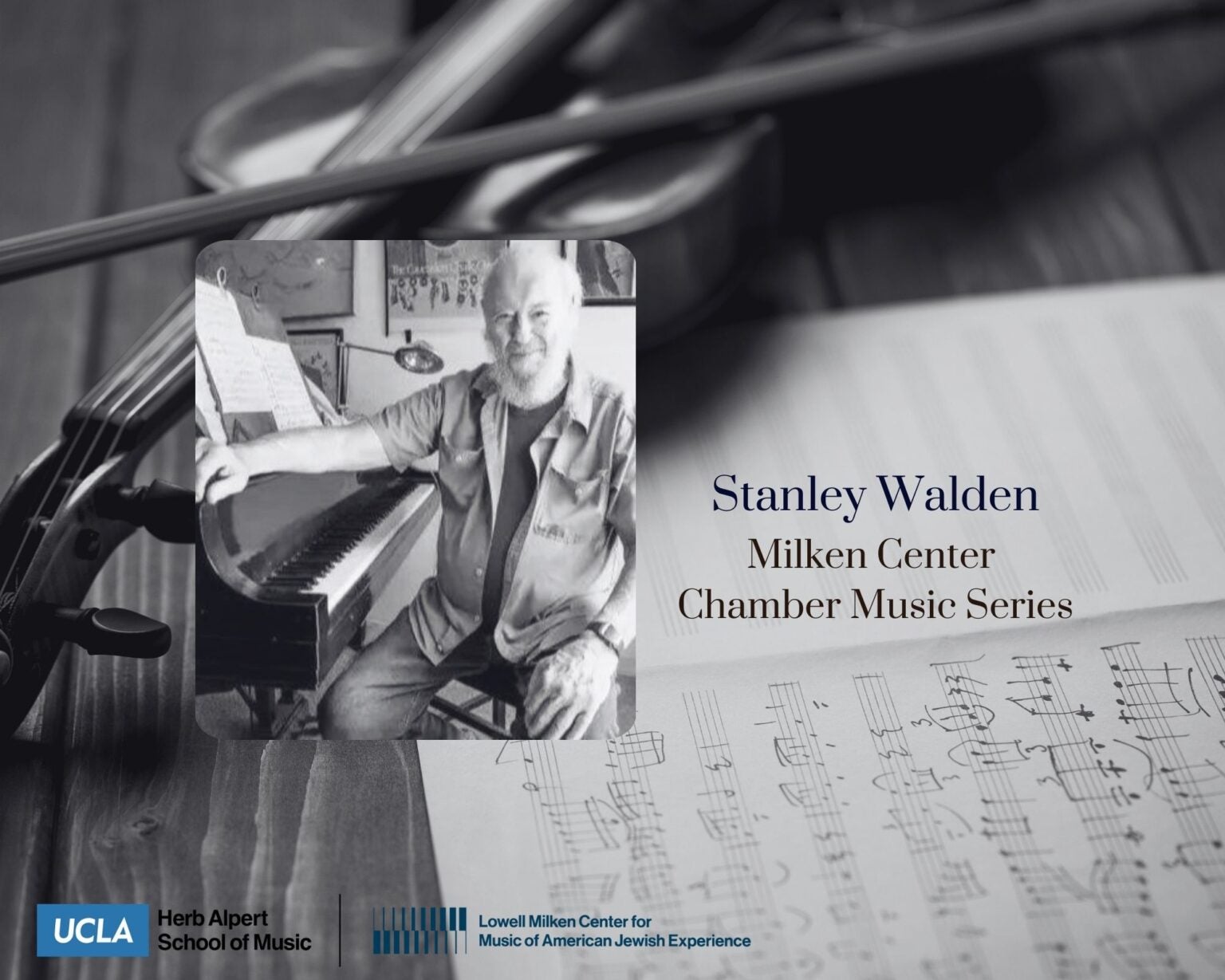
Composer Portrait:
The Music of Stanley Walden
4 PM Sunday February 16, 2025
Lani Hall at UCLA
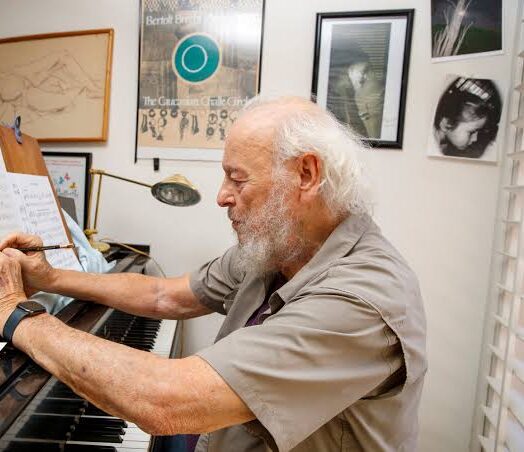
Stanley Walden
See Bio
Stanley Walden (born December 2, 1932) is an American composer, musical performer, and professor of musical theater. He has written music for the theater (musicals, operas, ballets) in America and Europe, as well as for the concert stage (Philadelphia, Chicago, Cleveland and Louisville Orchestras; and chamber music for Carole Cowan, Jan DeGaetani, Reri Grist, Gilbert Kalish, Joel Krosnick, Robert Levin and many others). He has also been a clarinetist, actor and director. He is perhaps best known for writing music and lyrics of the revue Oh! Calcutta! He has also written a number of song cycles.
Walden attended James Madison High School and studied modern dance with Merce Cunningham. He then attended New York University and Queens College, studying clarinet with David Weber and composition with Ben Weber. From 1953 to 1955 – and after serving in the U.S. Army as principal clarinetist of the 7th Army Symphony Orchestra in Stuttgart (1955–57) – he worked as musical assistant to choreographers such as Martha Graham, José Limón, Jerome Robbins and Daniel Nagrin until 1960.
From 1957 to 1970, Walden lived in New York, performing as a clarinetist. He has played with the New York Philharmonic Orchestra, the Metropolitan Opera Orchestra and as bass clarinetist with the New York Woodwind Quintet, among others, and was a founding member of the Contemporary Chamber Ensemble, the Gramercy Chamber Ensemble, the Penn Contemporary Players and performed with the Group for Contemporary Music.
In 1967, he founded, along with Peter Schickele and Robert Dennis, the composition and performing trio The Open Window. In 1969, they composed the music and lyrics to the revue Oh! Calcutta!, which went on to become the longest running revue in Broadway history. The Open Window received a Grammy Award nomination for best score from an original cast album.
In 1970, Walden joined The Open Theater and composed the music for The Serpent and The Mutation Show. He then went on to join The Winter Project with Joseph Chaikin.
In 1970, he met the Hungarian writer and theater director George Tabori. They collaborated on more than 50 theater productions, including Pinkville (New York 1970, Berlin 1971), Sigmunds Freude (Bremen 1975), The Sinking of the Titanic, My Mother’s Courage, Improvisations on Shylock (Munich 1980-81), Jubiläum (in which Walden acted a major role) and Peepshow (Bochum 1983-84).
Walden then went to the Vienna Burgtheater with Tabori and Claus Peyman, where Mein Kampf, Ballade der Wienerschnitzel, Requiem for a Spy, and The Goldberg Variations (1991) were produced. In Tabori’s own theater, Der Kreis (The Circle), they collaborated on Masada, Lear’s Shadow and For the Second Time, in which Walden starred with Hanna Schygulla. At the Berliner Ensemble, they produced The Brecht Files (1999) and The Earthquake Concerto (2002).
In addition, Walden has also composed his own stage works, such as a jazz opera of Gertrude Stein’s Doctor Faustus Lights the Lights (UA Cologne 1983, New York), the opera Liebster Vater (UA Bremen 1987, also produced in Berlin, Leipzig, Weimar and in New York in 2002) and Bach’s Letzte Oper, a work commissioned by Der Danske Oper, with libretto by Jess Ornsbro (UA Erfurt 2002).
He has composed numerous chamber works, both instrumental and vocal, and the orchestral works Circus (1969) for the Louisville Orchestra under Jorge Mester, later performed by the Chicago Symphony Orchestra (Seiji Ozawa) and the Cleveland Orchestra (Louis Lane); Invisible Cities, commissioned by the Philadelphia Orchestra under Erich Leinsdorf (1986); and Weewis, Margo Sappington’s ballet commission by the Joffrey Ballet (1973) and later performed by companies in Europe and Mexico.
Walden also composed the chamber symphony, After Auschwitz, which was performed at the Eastman School of Music at the University of Rochester (New York). It was also performed by the Budapest Strings Chamber Orchestra in Cividale del Friuli, Italy and by the Brandenburg Philharmonic in Potsdam, Germany.
His musicals include The Kid (American Place Theater, NY, 1972), Back Country (with Jacques Levy, 1979), Brecht’s The Caucasian Chalk Circle (Arena Theater in Washington, DC, 1978), Bahn Frei! (1989), Miami Lights (with Jacques Levy, 1990), Café Mitte (with Volker Ludwig, 1997), Claire (with Manfred Karge (Bochum, 1985, also Ghent and NDR TV), Die Bettler Oper (Renaissance Theater, Berlin, 1985), The Goldberg Variations Musical (Tabori in Karlsruh, 2016) and Butterfly Madam (with B. Peachy, Palm Springs, 2011)
Walden’s film scores include David Newman’s La fille d’Amérique (1977), Vadim Glowna’s Desperado City (1981), which won the Caméra d’Or in Cannes and in which Walden also acted, and George Tabori’s Frohes Fest for German public service television broadcaster ZDF.
During his extensive career, he has received acclaim as a conductor, author, actor (on stage and in film), director and educator. In 1991, he and his wife, Barbara Walden, founded the Musical/Show Department at the Berlin Universität der Künste (Berlin University of the Arts). In 1998, collaborating with Barbara Walden, he published the book Life Upon The Wicked Stage, which has become a standard work for training musical actors. In 2000, after resigning from his professorship at the Berlin University of the Arts, he continued to give workshops there in 2001. The Waldens also taught workshops at the Folkwang Schule in Essen, at the Theater Institute in Munich, in Moscow, at Sarah Lawrence College and at the California Institute of the Arts.
He served on the faculty of The Juilliard School at Lincoln Center (“Music for Dance”) from 1960 to 1964 and the Lincoln Center Institute (now the Lincoln Center Institute for the Arts in Education). He was a guest teacher at Yale University and the Eastman School of Music.
The parents of two sons, Matthew and Joshua, the Waldens lived in New York and Berlin before moving to Palm Springs, California, in 2007. Barbara Walden died in 2012. Joshua died in 2016.
Repertoire
Variations on a Yiddish Theme for string quartet (2022)
Xenia Deviatkina-Loh, violin
Michelle Sheehy, violin
Ben Bartelt, viola
Jeffrey Ho, cello
Five Similes: Miniatures for solo piano (1998)
…like a sigh (in memoriam, Terry Gittleman)
…like bullets (in memoriam, Zelda Dolgin)
…like memory (in memoriam, Stephen Sell)
…like a shadow (in memoriam, Tony and Sandy Black)
…like a smile (in memoriam, Jan DeGaetani)
Alex Tchaykov, piano
Coronach: A Kaddish for alto solo, English horn and speaker (1989)
Milena Gligic, alto
Thacher Schreiber, English horn
Neal Stulberg, speaker
Sh’mah for violin and cello (2002)
Xenia Deviatkina-Loh, violin
Jeffrey Ho, cello
- INTERMISSION –
Grandma (Millie) from Three Ladies for alto solo and piano (1983)
Milena Gligic, alto
Gaby Sipen, piano
Ballade von Mazeppa for baritone solo and piano(1986)
Jared Jones, baritone
Gaby Sipen, piano
Q & A from the stage, including showings of excerpts from selected stage productions
Program Notes
Texts and Translations
Grandma (Millie) from Three Ladies for mezzo-soprano solo and piano (1983)
Text (Jacques Levy)
She came over on the boat,
a dazed “greenhorn,”
and never learned to read or write,
but had her babies,
and her babies had babies,
and though some died,
And her husband, too
she sat and rocked her days,
and in the evenings
hummed the old songs in sweet innocence
And smiled, as if there were nothing to life
but loving me.
Ballade von Mazeppa for baritone solo and piano (1986)
Text (Bertholt Brecht)
Mit eigenem Strick verstrickt dem eigenen Pferde
Sie schnürten ihn Rücken an Rücken dem Roß
Das wild aufwiehernd über heimatliche Erde
Gehetzt in den dunkelnden Abend hinschoß.
Sie schnürten ihn so, daß den Gaul der Verstrickte
Im Schmerz noch aufpeitschte durch sinnloses Zerrn
Und so, daß er nichts, nur den Himmel erblickte
Der dunkler ward, weiter ward, ferner als fern.
Wohl trug ihn der Gaul vor der hetzenden Meute
Blind und verzweifelnd und treu wie ein Weib
Ihm riß er, je mehr seine Feinde er scheute
Tiefer den Strick im blutwäßrigen Leib.
Auch füllte sich abends dann seltsam der Himmel
Mit fremdem Gevögel: Gaeier und Kräh, die mit
Lautlosem Flug un dunklem Gewimmel
Im Äther verfolgen den keuchenden Ritt.
Drei Tage trug ihn der fleischerne Teller,
wiehend hinab an den ewigen Start,
wo der Himmel bald dunkel und wo er bald heller,
doch immer unermesslicher ward;
Drei Tage immer gehetzter und schneller
Drei Ewigkeiten lang war die Fahrt
Wo der Himmer bald dunkler und wo er bald heller
Doch immer unermeßlicher ward.
Drei Tage will er zum Sterben sich strecken
Er kann's nicht im Flug zwischen Himmel und Gras
Und die Geier lauern schon auf sein Verrecken
Un sehnen sich wild auf das lebende Aas.
Drei Tage, bis seine Stricke sich sträubten -
Grün war der Himmel, und braun war das Gras!
Ach! es rauften wohl immer zu seinen Häupten
Kräh und Geier sich schon um das lebende Aas!
Und ritt er schneller, sie folgten ihm gerne.
Und schrie er lauter, sie schrien mit.
Beschattend die Sonn und Beschattend die Sterne
Verfolgten sie seinen keuchenden Ritt.
Drei Tage, dann mußte alles sich zeigen:
Erde gibt Schweigen und Himmel gibt Ruh.
Einer ritt aus mit dem, was ihm zu eigen:
Mit Erde und Pferd, mit Langmut und Schweigen
Dann kammen noch Himmel und Geier dazu.
Drei Tage lang ritt er duch Abend und Morgen
Bis er alt genug war, daß er nicht mehr litt
Als er gerettet ins große Geborgen
Todmüd in die ewige Ruhe intrit.
Ballade of Mazeppa (English translation)
(https://lyrhub.com/track/Konstantin-Wecker/Ballade-vom-Mazeppa/translation)
Entangled with his own rope, bound to his own steed,
They strapped him back to back to the horse,
Which, whinnying wildly over familiar earth,
Dashed into the darkening evening.
They bound him so that the entangled stallion,
In pain, still whipped him on, through senseless struggle,
So that he saw nothing but the sky,
Which grew darker, wider, farther than far.
The steed carried him well before the hunting pack,
And blind and desperate and faithful as a wife,
The more he feared his enemies, the deeper he tore,
The rope into his blood-soaked body.
And strangely, in the evening, the sky filled
With foreign birds: crows and vultures, who with
Silent flight in dark turmoil
Pursue the gasping ride in the ether.
For three days the fleshy plate carried him,
Neighing down to the eternal start,
Where the sky was now darker, and now brighter,
But always grew more immense.
Three days ever more hunted and faster,
Three eternities long was the journey,
Where the sky was now darker, and now brighter,
And always grew more immense.
For three days he wants to stretch out to die,
He cannot do it in flight between heaven and grass,
And the vultures are already waiting for his demise,
And long wildly for the living carrion.
Three days, until his ropes bristled,
Green was the sky, and brown was the grass,
Ah, crows and vultures were already fighting over his head,
For the living carrion.
And if he rode faster, they gladly followed him,
And if he cried louder - they cried along,
Shading the sun, shading the stars,
They pursued his gasping ride.
Three days, then everything had to show itself,
Earth gives silence and heaven gives peace,
One rode out with what was his own,
With earth and horses and with patience and silence,
Then came heaven and vultures.
For three days he rode through evening and morning,
Until he was old enough that he no longer suffered,
As he was rescued into the great security,
Tired of death, he entered eternal rest.
