

uclaFLUX Fall Concert
UCLA Herb Alpert School of Music
Saturday December 6, 2025
Lani Hall
2:00pm
Director
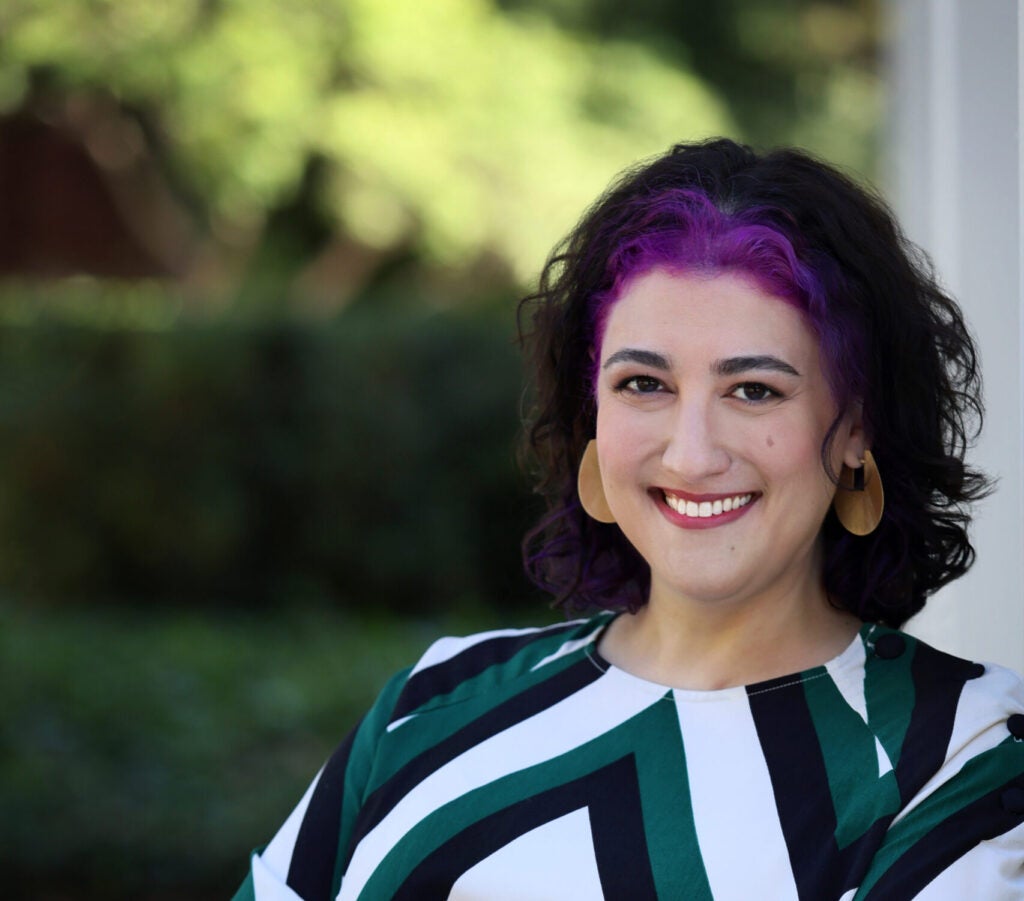
Wendy Richman
See Bio
Violist Wendy Richman has been celebrated internationally for her compelling sound and “absorbing,” “fresh and idiomatic” interpretations with “a brawny vitality” (The New York Times, The Washington Post). As soloist and chamber musician, she has performed at Carnegie Hall, Walt Disney Concert Hall, Royce Hall, Metropolitan Museum of Art, Mostly Mozart Festival, and international festivals in Berlin, Darmstadt, Edinburgh, Helsinki, Hong Kong, Karlsruhe, Morelia, and Vienna.
Richman is a founding member of the International Contemporary Ensemble (ICE), with whom she performs regularly in New York City and around the world. She collaborates with a wide range of composers, including commissions of works in which she sings and plays simultaneously. Her debut solo album, vox/viola, was released on New Focus Recordings (2020). She frequently performs with Los Angeles Chamber Orchestra and Los Angeles Philharmonic, and she has been a regular guest with Orpheus Chamber Orchestra and the orchestral viola sections of Atlanta, Minnesota, and St. Louis.
Also a distinguished educator, Dr. Richman serves as an academic lecturer at UCLA and as the viola instructor at California State University at Northridge (CSUN). She is a sought-after clinician at universities and conservatories across the country, offering classes on viola repertoire and technique, lectures on string instrument notation, and workshops on contemporary string techniques. She holds degrees from Oberlin Conservatory (BM), New England Conservatory (MM), and Eastman School of Music (DMA with Diploma in Ethnomusicology).
Dr. Richman’s research interests address musicians’ communities, stemming from her own experiences with composer-performer relationships, gender-based discrimination, and disability. Her own compositions link her love of unconventional string sounds with reflections on nature, physical trauma, and invisible disability.
Repertoire
Anuj Bhutani (b. 1993)
flightpath (2022)
Ella Scoville, alto saxophone, Bryan Chiu, horn, Ryan Heisinger, trombone
Samantha Reavis, piano, Jillian Risigari-Gai, harp, Ellie Loya, violin
Aidan Neuman, bass, Andrew Fresquez, conductor
Joan Huang (b. 1957)
Two Poems from Ancient China (1993)
Jillian Risigari-Gai, harp, Gan Xiong, voice
Andrés Nuño de Buen (b. 1988)
Pretexto (2015)
Amelie Yap, oboe, McCartney Hutchinson, trumpet
Nancy Ruczynski, piano, Wendy Richman, viola, Candice Oh, cello
Aidan Neuman, bass, Gan Xiong, conductor
Filipe Leitão
Dawn to Dusk (2017) for oboe and alto saxophone
Amelie Yap, oboe, Ella Scoville, alto saxophone
Evan Williams (b. 1988)
Metal Work (2014)
McCartney Hutchinson, trumpet, Bryan Chiu, horn, Ryan Heisinger, bass trombone
INTERMISSION
Élise Roy (b. 1988)
Lepidoptera (2019, version for uclaFLUX 2025)
McCartney Hutchinson, trumpet, Aidan Neuman, bass, Samantha Reavis, piano
Donald Crockett (b. 1951)
Horn Quintet ‘La Barca’ (1999)
Michelle Yang, horn, Makiba Kurita, violin, Wendy Richman, viola
Candice Oh, cello, Nancy Ruczinski, piano
Krzysztof Penderecki (1933-2020)
Duo Concertante (2010)
Ellie Loya, violin, Aidan Neuman, bass
Program Notes
Anuj Bhutani (b. 1993)
flightpath (2022) for open instrumentation (This performance features violin, double bass, harp, alto saxophone, horn, and trombone.) (15’)
As a kid, I dreamed of being a bird. To me, they were truly free: soaring across the sky, singing, looking down at us from the treetops, nesting anywhere they liked. As I got older, I was fascinated by the stories of their epic migrations. I imagine that though the departure and arrival points of these migrations are probably similar, each journey must be unique; when one rests, how close to the flock one flies, and the weather must make each trip unique. My hope is that flightpath provides a similar experience, where one knows the points of departure and arrival, but is free to shape their individual journey.
– Anuj Bhutani
Commissioned by Metropolis Ensemble and Brooklyn Botanic Garden for the 2022 Biophony Project. First performance given at Brooklyn Botanic Garden on May 14, 2022 by Metropolis Ensemble.
Described as “a force multiplier with more talents than time” (PATRON Magazine), “with a special gift for taking the personal and making it universal” (Beth Morrison, OperaWire), Anuj Bhutani is a quickly emerging composer, performer, vocalist, and producer whose “alternately celestial and dark” music (John Schaefer, WNYC New Sounds) often features visceral grooves; ethereal, meditative spaces; a combination of acoustic instruments and electronics, narrative depth, and genre-fluidity. As a first-generation Indian-American, Bhutani’s work is focused on liminal spaces, and is often highly interdisciplinary, engaging with theater, dance, and film while drawing on his musical background in classical, emo/screamo, ambient, singer/songwriter, and electronic music, resulting in genre- and culturally-fluid pieces that firmly situate the listener between multiple musical worlds at once.
His work has been presented by Beth Morrison Projects, MATA, American Composer’s Orchestra, and LA Performance Practice, and at venues including National Sawdust, ISSUE Project Room, So Laboratories, the Banff Centre, Tuesdays @ Monk Space, Unwound Sound, the DiMenna Center for Classical Music, Oracle Egg, USC’s Visions + Voices series, and more.
He earned his master’s degree at University of Southern California where he was awarded Outstanding Graduate in Composition and his bachelor’s degree at University of North Texas. His previous teachers have included Andrew Norman, Ted Hearne, Camae Ayewa (Moor Mother), Joseph Klein, Andrew May, Sungji Hong, Drew Schnurr, and UNT Composer-in-Residence Bruce Broughton. He also holds a BA in Psychology from UT Austin. http://anujbhutani.com
Joan Huang (b. 1957)
Two Poems from Ancient China (1993) for harp and baritone voice (10’)
Composer Joan Huang grew up and received her early music education with her parents in Shanghai, China. During the China’s Cultural Revolution, as a teenager, she was sent to a farm to do heavy manual labour for three years. At the same time, she had the opportunity to learn folk music from local farmers.
After the Cultural Revolution, Huang was one of the very few applicants to be selected from a gigantic pool of candidates at the time of reopening of the Shanghai Conservatory of Music; the closing of which during the so-called Cultural Revolution had denied ten precious years of musical education to many talented musicians. After receiving her BA in 1983, Huang was the only student to be chosen to study a Master of Arts under the guidance of Mr. Sang Tong, the President of the Shanghai Conservatory then. She was the first female student to receive the MA degree in Composition in the 59-year history of the conservatory.
In 1986 Huang came to the United States to continue her education at the University of California at Los Angeles where she studied with Elaine Barkin, William Kraft, and Roger Bourland. She became very interested in creating a style of fusion of Chinese traditional musical language with Western contemporary compositional techniques. She has received several awards, including two from Phi Beta for international students, one Tanglewood Music Festival fellowship and two Aspen Music Festival Scholarships. She received her Ph.D. from UCLA in 1991.
As a composer, Huang has had commissions and performances from outstanding organizations and performers. Huang’s The Legend of Chang-e won the first prize of 1994 Marimolin’s International Composition Contest.
- Pú-sa-mán(Beautiful Barbarians)
菩萨蛮
- Shui-diao-ge-tóu(Drinking in the Mid-autumn Night)
水调歌头
Both poems are inspired by ci (pronounced tschi) poetry, also known as “lyric songs.” Ci poetry was extremely popular in both the Tang Dynasty (618-907) and the Song Dynasty (960-1279). During this timeframe, the poetry was often recited to music, for which historians believed there were over 800 melodies based on the poetry. Unfortunately, a majority of these melodies remain lost. When hearing Joan Huang’s mix of melodic and atonal melodies for both movements, she manipulates the lyrics of long and short lines according to fixed rhythmic and tone inflections. For both movements, the harp sets a tone of free ambiguity, enhancing the baritone’s sung text with a plethora of extended techniques inspired by the traditional Chinese instrument guqin. From the glissandi and fermatas at moments in both movements, Huang moves to very strict rhythmic nuances that further guide the work’s dramatic character, further enhancing the text. – Jillian Risigari-Gai
- Pu-sa-man (Beautiful Barbarians)
By Li Po (701-762)
Trees shading trees, mist-smoke weaves.
Cold mountains, a belt, of heartbreaking green.
Dusk enters a high tower;
In it someone grieves.
All alone upon the jade terrace;
Homing birds return in haste.
Where is the way to return?
Long rest, short rest, bower after bower.
The composer’s interpretation of this poem:
This poem expresses the author’s homesick mood. The first half describes that Li Po was alone, grieving, facing misty-smoky trees and cold mountains. The second half describes birds’ anxious desire of returning home and implies that Li Po’s home was very far away. Here, Li Po’s idea of returning home in haste was suggested by birds.
- Shui-diao-ge-tou (Drinking in the Mid-autumn Night)
By Su Shi (1037-1101)
When did the moon begins to shine?
Lifting my cup I ask of Heaven.
I wonder in the heavenly palaces and castles
What season it is tonight.
I wish to go up there on the wind,
But am afraid the crystal domes and jade halls
Would be too cold on high.
So I dance with my limpid shadow
As if I were no longer on earth.
Around rich bowers,
Into sweet boudoirs,
Shining upon the sleepless.
The moon should have no regrets,
Why is she always at the full when men are separated?
Men have their woe and joy, parting and meeting;
The moon has her dimness and brightness, waxing and waning.
Never from of old has been lasting perfection.
I only wish that you and I may be ever well and hale,
That both of us may watch the fair moon, even a thousand miles apart.
This is a very popular mid-autumn poem. Su Shi wrote this poem during the times of his political banishment. In the first half, he imagined himself in a beautiful world of legend due to his resentment of reality. In the second half, Su Shi expressed the feeling of parting between his brother and himself through the moon. This is a significant poem in the history of Chinese poetry because Su Shi broadened the scope of ci poetry by introducing more serious subject matter and thus made it a more substantial genre. His poetry is fresh, bold and vivid in style.
Both poems express the agonies of parting and the nostalgia of exile through the descriptions of nature. In order to be identical with the poetic sense, I try to let the music provide the texture of the emotional content. Especially, I made the voice part prolong the chanting of the melodious recitation quality of ci poetry, i.e. constant dynamic shifting, rising, and falling with glissandi between registers, etc. In addition, the baritone sings in the original Chinese, and most pitches are compatible with the inflections of the Chinese Mandarin language. The harp utilizes wide timbral qualities and various performance techniques to match the dramatic quality of the poems. – Joan Huang
Andrés Nuño de Buen (b. 1988)
Pretexto (2015) for oboe, trumpet, piano, viola, violoncello and double bass (10’)
Pretexto was made with the financial support of Mexico’s National Fund for Culture and the Arts through its “Jóvenes Creadores 2014-2015” Grant. The piece was written for a collaboration between the Badische Staatskapelle‘s new music concert series Nachtklänge and the HfM Karlsruhe. – Andrés Nuño de Buen
Sensory perception is central to the work of Andrés Nuño de Buen (Mexico City, 1988), who strives for an immediate sensuality in his music. The Berlin-based composer creates his pieces through subtle processes of sound shaping with acoustic instruments, electronic media, objects, and self-made instruments.
Nuño de Buen was awarded the first prize of the 67th Kompositionspreis der Landeshauptstadt Stuttgart (2022) for his work Leve for the ALEPH Guitar Quartet. His music has been performed in festivals and concert series in Mexico, the US, Spain, France, Germany, Austria, Switzerland, Sweden, Turkey, Russia and Japan, and has been supported by institutions such as the Berlin Academy of Arts and the Mexican Secretariat of Culture.
He studied with Wolfgang Rihm and Markus Hechtle at the Hochschule für Musik in Karlsruhe, and with Alejandro Romero and José Luis Castillo at the Escuela Superior de Música in Mexico City. http://andresnunodebuen.de/
Filipe Leitão
Dawn to Dusk (2017) for oboe and alto saxophone (6’)
A duo for oboe and alto saxophone composed by, inspired and influenced by the compositions of Claude Debussy, featuring fluid tonal centers, liquid rhythms, and exotic scales. Since it was written for two melodic instruments, it mainly incorporates Debussy’s use of tone color, melodic construction, and writing style to evoke a sense of incompletion through fragmented ideas and harmonic movements that attenuate the sense of tonality, leaving to the listener a dreamlike atmosphere. The piece essentially features three sections, with the first and last sections being more lyrical, featuring a fluid rhythm, and the middle one more energetic. – Filipe Leitão
Filipe Leitão is an award-winning composer, music producer, and educator. He is Associate Professor at Virginia Commonwealth University, where he developed and leads the Media Scoring program. He earned the Doctor of Musical Arts degree at The University of Alabama, a Master of Fine Arts degree in Music Production and Sound Design for Visual Media at the Academy of Art University (San Francisco, CA), and a Bachelor in Art Education at the University of The State of Pará, in Belém, Brazil, where he served as an Assistant Professor at the Federal University of Pará. As an educator, he has taught composition, orchestration, music production, and film scoring.
Dr. Leitão has collaborated with many artists, creating original compositions and sound design for films and video games, as well as he has written electronic works, and concert pieces for varied ensembles. His works reflect his unique voice originated from a mix of classical music, popular music, Brazilian music, and film music, and have been recognized at both national and international levels, and obtained prizes and performances on renowned film and music festivals, including New York Electroacoustic Music Festival, Electronic Music Midwest, University of Tennessee Contemporary Music Festival, SCI Conferences, Belgian Saxophone Choir, North American Saxophone Alliance Conference, Cannes Short Film Corner, Toronto Film Week, Anima Mundi, and WorldFest Houston, to name a few.
In addition to his work as a composer and educator, Dr. Leitão also develops professional sample libraries and virtual instruments for composers and producers, combining musical creativity with cutting-edge sound design to empower artists worldwide. http://filipeleitao.com
Evan Williams (b. 1988)
Metal Work (2014) for brass trio (12’)
- Iron
Symbol (Fe), a hard metal that has proved important throughout history in construction and warfare. It is also an essential element in the proper function of the body’s blood cells.II. Alloys (Passacaglia)
Metals created by a mixture (fusion, blend) of multiple metallic elements. The result is a stronger or less corrosive metal than the sum of its parts.III. Steel
An alloy in which iron is the primary element. It is especially important in the construction of commercial buildings.Metal Workwas commissioned by the V3NTO Trio. – Evan Williams
Drawing from inspirations as diverse as Medieval chant to contemporary pop, the music of composer and conductor Evan Williams (b. 1988) explores the thin lines between beauty and disquieting, joy and sorrow, and simple and complex, while often tackling important social and political issues. Williams’ catalogue contains a broad range of work, from vocal and operatic offerings to instrumental works, along with electronic music.
His music been performed and commissioned by the International Contemporary Ensemble, Urban Playground Chamber Orchestra, Quince Ensemble, and by the Cincinnati, Toledo, Detroit, Seattle, and National Symphonies. His work has received awards and recognition from the American Prize, the National Federation of Music Clubs, ASCAP, and Fellowships from the Virginia Center for the Creative Arts. In 2018, he served as the Detroit Symphony Orchestra’s inaugural Classical Roots Composer-in-Residence. He currently serves as the Steven R. Gerber Composer-in-Residence for the Chamber Orchestra of Philadelphia.
Williams holds degrees from the College-Conservatory of Music at the University of Cincinnati, Bowling Green State University and Lawrence University. He currently serves as Assistant Professor of Composition at the Berklee College of Music, where he teaches composition, conducting, music technology, harmony, and counterpoint. http://www.evanwilliamsmusic.info/
Élise Roy (b. 1988)
Lepidoptera (2019, version for uclaFLUX 2025) for trumpet, double bass, piano, and fixed media electronics (10’)
Élise Roy composed Lepidoptera in 2019 for SPLICE Ensemble, a trumpet, piano, and percussion trio focused on electroacoustic chamber music. Lepidoptera is a scientific order including butterflies and moths; in this work, Roy explores the insects’ darker, nocturnal qualities through sustained chords and clusters, sparse textures, and chiaroscuro juxtapositions of sound. The fixed media adds layers of fluttering and breathing, while the live musicians take turns both complementing and contrasting with the electronics: they employ such extended techniques as scratch and sub tones on the bass, slapping the strings of the piano, and screaming through the trumpet. uclaFLUX is indebted to Élise for her generosity in creating this version of Lepidoptera, of which tonight’s performance is a premiere. -Wendy Richman
Based in Denver and Los Angeles, Élise Ming Chu Roy is a freelance composer, flutist, and improviser. Her work consists of sonic collages of digital and acoustic materials. In recent pieces she has created complex sound worlds by layering traditional instrumental sounds and extended techniques with audio that included samples of NASA space missions and field recordings of elephants. Amongst her current projects is being a co-director and flutist for the tiny backpack series in Los Angeles. She can also be found teaching flute and computer music at University of Colorado Colorado Springs.
Élise has been commissioned by ensembles such as the LA Phil, gnarwhallaby, Brightwork New music, House on Fire, and the SPLICE ensemble. Her music has been performed at festivals all over the world including PAS-E (Venice, Italy), SEAMUS (Blacksburg, Virginia), and NYCEMF (New York City), and she is a recipient of an ASCAP/SEAMUS commissioning award. Previously she was an associate director of the wasteLAnd concert series and a flutist in the wasteLAnd ensemble. Élise has previously taught electronic music and coached chamber music at the SPLICE Institute, Chapman University, and the New Mexico School for the Arts.
Élise is a graduate of Oberlin College and Conservatory, where she earned double undergraduate degrees in neuroscience and flute performance studying under Michel Debost and Kathleen Chastain. She is also a graduate of CalArts where she earned a master’s degree in flute performance studying under Rachel Rudich. After leaving school, she studied composition privately with Erik Ulman. https://www.eliseroy.com/
Donald Crockett (b. 1951)
Horn Quintet ‘La Barca’ (1999) for horn, violin, viola, cello, and piano (16’)
Horn Quintet ‘La Barca’ was commissioned for the 1999 Music from Angel Fire festival with the generous support of the Bruce E. Howden Jr., American Composers Project. This is the third ‘water music’ piece which I have written. The others are ‘to be sung on the water’ (1988) for violin and viola and ‘Wedge’ (1990) for orchestra. (The Wedge is a famous bodysurfing spot in Southern California.) This Horn Quintet carries the subtitle ‘La Barca’ (‘the boat’ in Italian) primarily because the entire work, which lasts about 15 minutes, is moving toward a barcarole at the end. Even ‘la barca’ itself seems to rock on the tongue in the manner of a gondola. (‘The boat’ just doesn’t cut it.) After a brief opening ‘motto’ featuring stopped horn and muted piano, the character of the extended first section suggests water music: rocking chords in the string trio and piano accompany an extended lyrical solo in the horn. This returns in varied form just before the barcarole. A good deal of the middle of the piece is fast, with the chords of the opening transformed into syncopated rhythms and rapid alternation between strings and piano. The horn again takes the lead here, as it does in most of the piece. By way of contrast, some of the piece features slower tempi: in addition to the ending barcarole there is a slow section in which a sinuous melody in the horn is partially echoed in the strings and reprised in the piano. – Donald Crockett
Los Angeles-based composer and conductor Donald Crockett has received commissions from a wide spectrum of organizations including the Los Angeles Chamber Orchestra (Composer-in-Residence, 1991 – 97), Kronos Quartet, Los Angeles Philharmonic, Hilliard Ensemble, Pittsburgh New Music Ensemble, Xtet, the San Francisco-based chamber chorus, Volti, the Guitar Foundation of America, and the University of Southern California for its 125th anniversary, among many others. Featured projects include an all-Crockett orchestral disc released in May, 2015 by Boston Modern Orchestra Project on BMOP/sound, commissions from New Music USA for SAKURA cello quintet, Kaleidoscope Chamber Orchestra, Aspen Music Festival and Oberlin Conservatory for And the River, a concerto for duo pianists and chamber orchestra, Aspen and Oberlin for his Violin Concerto, the Harvard Musical Association for violist Kate Vincent and Firebird Ensemble, Boston Modern Orchestra Project and JFNMC for his Viola Concerto, a chamber opera, The Face, based on a novella in verse by poet David St. John, a consortium commission from twenty-two college and university wind ensembles for his Dance Concerto for Clarinet/Bass Clarinet and Wind Ensemble, and commissions for new string quartets from the Dilijan Chamber Music Series in Los Angeles and the Caramoor Festival in New York. The recipient in 2013 of an Arts and Letters Award in Music from the American Academy of Arts and Letters for outstanding artistic achievement, as well as a Guggenheim Fellowship in 2006, Donald Crockett has also received grants and prizes from the Barlow Endowment, Bogliasco Foundation, Copland Fund, Copland House, Kennedy Center Friedheim Awards, Meet the Composer, the National Endowment for the Arts, New Music USA and many others. His music is published by Keiser Classical and Doberman/Yppan and recorded on the Albany, BMOP Sound, CRI, Doberman/Yppan, ECM, Innova, Laurel, New World, Orion and Pro Arte/Fanfare labels. A frequent guest conductor with new music ensembles nationally, Donald Crockett has been very active over the years as a composer and conductor with the venerable and famed Monday Evening Concerts in Los Angeles, and most recently the Jacaranda concert series in Santa Monica. In 2022, he returned for his sixth season leading the Aspen Contemporary Ensemble for the opening weeks at the Aspen Music Festival. As conductor of the USC Thornton Symphony’s annual New Music for Orchestra series, Donald Crockett has premiered over 150 new orchestral works by outstanding Thornton student composers. His recordings as a conductor can be found on the Albany, CRI, Doberman/Yppan, ECM and New World labels. Deeply committed to education, Donald Crockett is Professor and Chair of the Composition Program and Director of Thornton Edge new music ensemble at the USC Thornton School of Music, as well as Senior Composer-in-Residence with the Chamber Music Conference and Composers’ Forum of the East. http://donaldcrockett.com
Krzysztof Penderecki (1933-2020)
Duo Concertante (2010) for violin and double bass (6’)
During his long career as the leader of avant-garde Polish music, Penderecki has made many creative friendships. One of his closest in recent years has been with the German violinist Anne-Sophie Mutter. Their collaboration has generated three major works: the Second Violin Concerto (“Metamorphoses”), the Second Violin Sonata, and this Duo concertante per violino e contrabbasso. Mutter’s foundation for the encouragement of young string players issued the commission for the Duo concertante, which Mutter premiered with one of her scholarship holders, Roman Patkoló.
Penderecki adopted the Italian title referring to a piece for two solo performers. His research turned up a single precedent for the odd combination of violin and double bass, an arrangement of a Gran duo concertante originally written by Giovanni Bottesini in 1880 for two double basses and orchestra. The extreme difference in the pitch ranges of the two instruments explains the paucity of repertoire. Here, Penderecki partially addressed the problem by having the strings of the double bass tuned a whole tone higher than customary.
What resulted is a surprisingly lyrical, rhapsodic, and emotionally rich musical conversation. Mostly the players take virtuoso turns in the spotlight, in question-and-answer format, with one instrument providing quiet accompaniment while the other holds the floor. The main theme is a motoric five-note figure tossed back and forth like a ball. Special effects abound. At the end, the double bassist strikes the instrument’s body with hand and knee before joining the violinist in bowing behind the bridge. https://www.laphil.com/musicdb/pieces/4846/duo-concertante-por-violin-e-contrabbasso
Support for this course was provided by the UCLA Teaching and Learning Center (TLC) to advance educational innovation; elevate teaching; and foster engaging, accessible learning experiences for all students.
Special thanks to Anuj Bhutani and Élise Roy for their invaluable visits, and for their time and generosity in creating versions of their pieces that are ideal for uclaFLUX. Thank you to Donald Crockett, Joan Huang, Filipe Leitão, Andrés Nuño de Buen, and Evan Williams for providing perusal scores of their works, and to Luis Henao, Jose Carrillo, and Chandara Tep from Music Technology and Production for consistently going above and beyond the call of duty. And finally, thank you to Matthew Vest and Henry Lim of UCLA’s Walter H. Rubsamen Music Library for their time and support.
About uclaFLUX (Dr. Wendy Richman, director)
uclaFLUX is devoted to the study and performance of chamber music from the 20th and 21st centuries. We explore and embrace new performance approaches and techniques associated with the dynamic, ever-evolving languages of contemporary music, building on skills learned through the study of traditional chamber music.
In preparing to perform and produce quarterly concerts, students learn innovative modes of expression, interact directly with composers, and develop skills in concert promotion, production, and entrepreneurship. Repertoire is selected according to enrollment, though pre-formed groups and repertoire requests are welcome.
One of uclaFLUX’s major goals is to highlight music by living composers, especially Los Angeles-area, California, and West Coast composers, with a particular focus on works by composers who are BIPOC, LGBTQIA+, women/gender-marginalized, disabled, and from other groups underrepresented in classical and contemporary classical music.
