
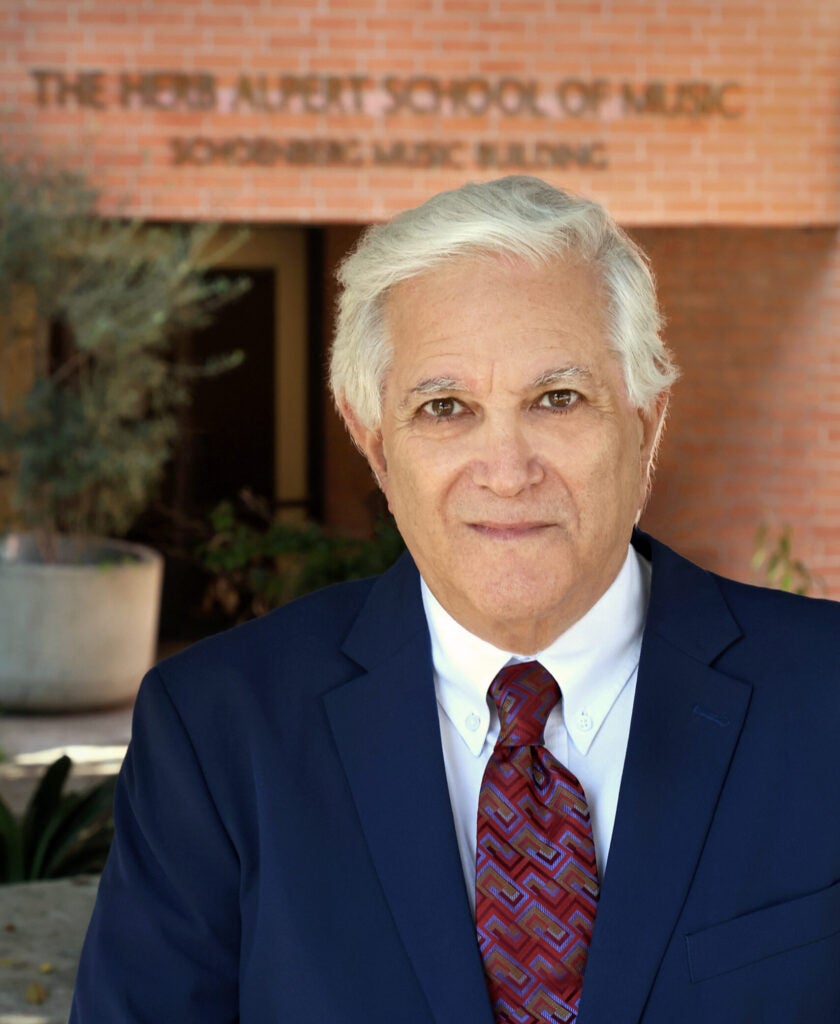
Michael Beckerman, the new dean of The UCLA Herb Alpert School of Music, is a leading music scholar. His groundbreaking studies of Central European composers have been praised for their quality and are highly influential in the field. Beckerman has also reached beyond academic specialists to the broader public. He is a frequent contributor to The New York Times and has produced programs for NPR, PBS, the BBC, German Public Radio, CBC and Irish Radio, among others.
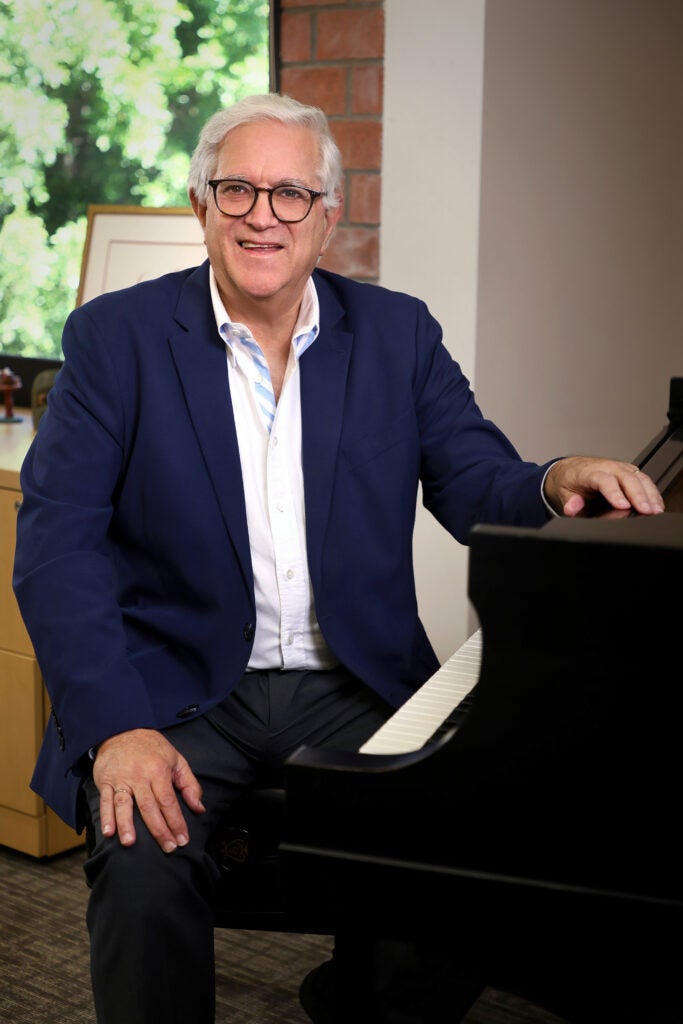
Beckerman began his term as dean on September 15, 2025, quickly settling into his office on the second floor of the Schoenberg Music Building. Along with his books, historical artifacts and art, he moved in a six-foot, four-inch Steinway Grand. He takes to the piano bench frequently throughout the week, whether to play Horace Silver’s Song for My Father, Adam Michna’s The Friendship of Angels (Czech 17th century), or Czech folk tunes, or just to help him think.
Rarely at his desk for long, Beckerman can be found walking the halls, either chatting with students or visiting faculty and staff. Despite his busy schedule as new dean, he sat down for a wide-ranging interview about his scholarly career, what attracted him to UCLA, and his vision for the school of music.
# # #
Where were you when you first heard about the search for a new dean of The UCLA Herb Alpert School of Music?
I was sitting at my desk at NYU, and I received an email saying, “we’d like you to consider applying for this job.” And I thought “I don’t think you’re interested in someone like me.” But they kept after me, and I started to think that UCLA was an intriguing possibility.
What intrigued you?
There are a great number of things that were attractive about this job. Some of them are obvious. There’s a big advantage to being at the flagship university. You attract talented students; you have more resources. And there’s UCLA’s international reputation for excellence. But there are a lot of pressures, too. So, I really thought about it. And I said to myself—and I stand by this statement today—this is both the most exciting and the most challenging job that I could think of.
Let’s start with what you found exciting.
First of all, it’s the quality of the faculty. You have some powerful original thinkers in every area. You’ve got some terrific performers. UCLA also has a great history. The ethnomusicology department is truly legendary. And in my particular field, which is musicology, UCLA has been one of the leading players in the country.
And another exciting aspect is that all these different people—scholars, composers, theorists, musicians, directors, pedagogues, conductors—are in the same place. One of the things I really missed at NYU was the kind of synergy between performance and scholarship, or what I’ve sometimes called “action” and “reflection.” And I think there are tensions between these two worlds of action and reflection. But these tensions are necessary, and they can be productive.
What do you mean by tensions?
My father taught theater, and I came to realize that there were two Shakespeares. There was one Shakespeare who lived in the English department, where Shakespeare was a text which you could analyze very deeply, and you could never really know who Hamlet was or exactly what was going on in his head. And then there was another Hamlet in the theater department where directors didn’t have the luxury of not knowing who Hamlet was. They had to put Hamlet into action.
You see these tensions in the school of music?
At UCLA we have scholars studying opera as text and artists directing operas. And both are important. Too much action without reflection, and you make a mess. But too much reflection without action—it’s just too easy to sit on the sidelines and critique all the tough decisions that artists and directors have to make. Both are necessary and both are here at the school of music.
You said that UCLA was both the most exciting and the most challenging job you could think of. What makes it challenging?
Having all our academic and performance departments in the same place isn’t enough—we need collaboration. And getting scholars and artists to cross disciplinary lines and collaborate can be a challenge. I mean, there are reasons why academics are in departments, and you have to respect the integrity of programs. And one of the worst things I can imagine would be “forced interdisciplinarity.” Any collaboration that begins by administrative fiat is going to fail. The faculty have to be willing to work together, and they have to respect each other. It’s my job to help create the conditions in which people can come together and interact, to stimulate fresh ideas.
You’ve been in the role of dean now for a few weeks. What are your early impressions?
I was really thrilled to speak at the school of music’s Fall Welcome this year. I was so honored and surprised by the opening musical set. [Travis J. Cross, director of bands, led UCLA brass and percussion students in the performance of the fanfare from Leoš Janáček’s Sinfonietta to welcome Dean Beckerman.] That Janáček fanfare is one of my favorite pieces, and it’s not easy to put together. You need a large contingent of brass, and you need percussion—it’s difficult to do. It was really touching. I mean, I’m not a choking-up-in-public guy, but that moment was close.
At the Fall Welcome, you visited every academic program’s breakout session between faculty and students.
That was partially thanks to Adam Fox [director of student affairs]. Adam suggested it, and I certainly wanted to do it, and he helped me arrange it and get around.
What was your impression?
I was struck by how different the vibe was with the students in each of the programs. I was able to talk to musicology students about their projects. They were having great discussions in the room where global jazz was meeting, everything from the classics to new music. And then over in music industry, you had students going up on stage [in Lani Hall] and talking about the student record label. There’s real energy in each of the cohorts.
You’ve already held two graduate student mixers, and you host a weekly “Dean’s Drop In” where the door is open to everyone—faculty, staff and students. How are these going so far?
They’ve been lovely. My first drop-in was small, but what was great was that three first-year undergraduates came by. They just stopped in to meet the dean, just like you would at a small liberal arts college. We had interesting discussions about what they’re doing and where they’re from, and I thought: what an honor for me to be here at that moment with them. I’m hoping people will feel comfortable coming by in coming weeks.
You know, this school of music is a great place to have a “live” vibe. We prize live music for a reason, and I think that the live academic experience has a lot of value too. I want to support that. I’m starting with graduate student mixers and drop ins—informal spaces. A lot of great things happen right outside the classroom, during informal moments. I want to create opportunities for people to meet each other, to have robust discussions, and to challenge each other.
What do you mean by “challenge” each other?
I’m not a huge fan of agreement. I mean, I don’t want to see people in nasty quarrels, but I think that an environment where everyone is in agreement is just not very interesting. Part of why you are in a university is to figure out what you know, how you know it, and then how to express that to other people. And other people may not buy your arguments or ideas, so you have to figure out how to present them. I think that is what makes for a good community. It requires trust and it requires humility, because sometimes you’re bested in an argument. And that’s how you grow.
Sometimes that growth is uncomfortable. That’s a part of it. One thing that I want to see, for our students and our faculty, is an environment where they can fail. I remember reading Richard Feynman, the physicist, who said that scholarly articles were all nonsense because they were simply a record of your successes. Where were the footnotes about the cul-de-sac you went down for ten years? The failed experiments?
The same thing applies to a school of music. We want an environment here where people can fail—not because they’re bad, but because they are trying really hard stuff. And if we want people to be at the top of their game, then we want them taking risks, pushing themselves.
Let’s talk about your own background. What initially prompted you to go to graduate school?
I originally wanted to study composition. And I also really wanted to go to Columbia, but, at first, I didn’t get in. You know, I remember when I got the rejection. I went and just sat in the middle of a football field. It was a real punch in the gut.
What did you do?
I went off to take a bike trip across Europe. My bicycle and money were stolen almost immediately—it’s a long story.
In any case, I ended up back in New York and I started working at a record store. It was called “The Record Hunter.” It was at Forty-Second Street and Fifth Avenue. I listened to a lot of music there, and everyone in there talked about music.
In those days, every good record store in New York had these salesmen who came in and knew all the great conductors, had great stories to share and they would sell us records. And one day a guy with white hair named Otto Quitner came in and introduced himself to me. He was a representative for a Czech and Hungarian record label. He said, “You seem like an avid young guy. You know, nobody knows how to pronounce the names of these composers, and nobody knows the music. I’ll send you free records every month. And you’re not obligated to sell anything, but if you like the music, sell it to your customers.” And so, I would get a package of Czech music recordings every month. I really became fascinated by that repertoire.
And you pursued that in graduate school?
Well, when I finally got into Columbia, I originally went to study with Christoph Wolff, the great Bach scholar, and so I was going to craft a project around Bach or Mozart. But he left Columbia for Harvard in my first year, so I had to find something else. And I was the only person who could pronounce the names of the Czech composers, so I was seen as something of an expert.
I’m not saying it was fate, but it felt like fate. My advisor left, there wasn’t anyone else I was really wanting to work with, so I was able to just go off in my Czech direction and work on that.
You are quite prominent in your field. But did you have a sense when you were working on Czech music in graduate school that you were doing something really innovative, something truly original?
I think to say that would just be self-flattery. It’s hard to do new, original things. We sometimes put a premium on innovation in scholarship and in the arts. But we have to remember that people have been doing what we do for centuries, and a lot of them were pretty talented and smart. So, you have to have a little bit of arrogance when you set out to do something original. And then you realize how hard it is to actually do the work that we do [as scholars and artists] and you learn a little humility.
You spoke before about the tension between action and reflection that can be productive in the academy. It sounds here like you are juxtaposing innovation on the one hand and respect for tradition on the other—do you see these two things in tension as well?
Yes. I think it’s very easy to demonize the traditions. But this is where humility can also come into play. Nothing on this planet is going to be pure. Things that we are valorizing today might be something we look askance at in the future. And we also have to have curricula, to understand what the traditions are so you can reflect on them and critique them. And this is true in any kind of musical tradition.
So, when we ask the big questions—how does music work? How do we find meaning in music? How do we process language when it is used in music?—these are all unanswered questions. The fact that, after all these years we are still looking for answers, that calls for modesty rather than arrogance.
Importantly, we need to create a school where faculty and students aren’t afraid to ask the questions and aren’t afraid to try and to fail. We need innovation. We need tradition. And we need an environment where these things happen all around us.
On a closing note—what guidance would you give to students today?
I really want to encourage students to be open, to take different things from different places. Resist the natural tendency that we all feel when we are insecure—to batten down the hatches. When someone says, “doesn’t everyone know this?” If you don’t know it, you should raise your hand and say, “I don’t know it.” Don’t be ashamed of what you don’t know. Faculty are here to help you learn. And faculty aren’t people who have it all figured out. The best of them are people who are still out there trying, taking risks, and failing. It takes a lot of that failing to do something big and great.